Interreligious Festivals and Democracy Events in Gera
Interreligious Events & Cultural Festivals in Gera (Outlook & Orientation)
How you can find interreligious encounters and cultural festivals in Gera in the future, what you should pay attention to regarding dates (online/in-person), and why low-barrier information plays a central role.
Where You Can Reliably Find Upcoming Dates
So that you don't come across outdated information for interreligious events and cultural festivals in Gera, it is worthwhile to combine several sources. For the future, these ways are particularly robust:
- Official event calendars (municipal, cultural institutions, established organizers): Look for a clearly visible update date.
- Websites of communities, cultural centers, and initiatives: Many announce upcoming program points there first.
- Local media & newsletters: Often the fastest for short-term changes (e.g., weather-related location changes).
- Analog notices: Display cases, notices, posters in the city center, information in community centers.
A good practice standard for all announcements (and for you as a visitor a quality feature) is: Date, time, exact location, low-barrier information, contact and, if possible, a short sentence about the character of the event (e.g., "open to all," "family-friendly," "no registration required").
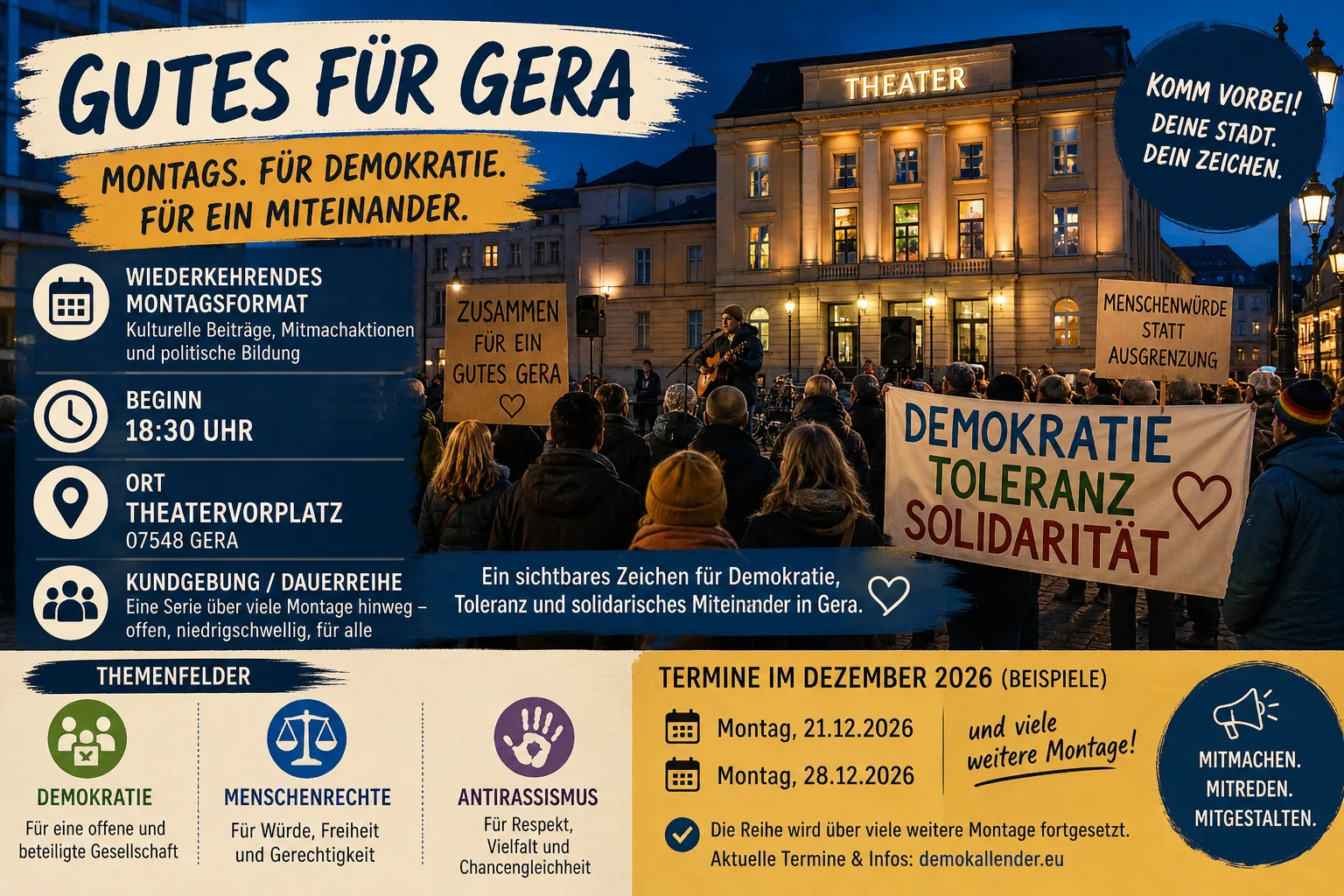
Example City Center: Open Monday Formats at the Theater Square
In city centers, interreligious and intercultural encounters often arise where people pass by anyway: in squares, at cultural venues, or at public rallies with cultural programs. For Gera, the Theater Square is obvious for this, as it is centrally located and suitable for low-threshold formats.
If a public Monday series is announced for the future (often with topics like democracy, human rights, anti-racism), it can also become relevant for interreligious encounters—even if it is not explicitly advertised as "interreligious." Because:
- Cultural contributions (music, readings, art actions) appeal to people of different backgrounds.
- Open conversation situations promote respectful exchange—including about values, traditions, and life paths.
- The public space lowers thresholds: You can listen first and participate actively later.
For your planning in the future: Always check the most current announcement in advance (location, start time, duration, any requirements). This way you avoid misunderstandings and stay flexible in case of changes.
Culture Connects: Intercultural Cooking, Art & Dialogue
Many of the most accessible interreligious encounters arise through formats that do not start with questions of faith, but with shared activities. For upcoming programs in Gera, three types of events are particularly effective—because they enable encounters "on the side":
1) Intercultural Cooking & Eating
Cooking together is a proven bridge builder: Recipes, eating habits, and festive cuisines make diversity tangible without anyone having to justify themselves. When future cooking evenings are announced, look for information about allergens, vegetarian/halal/kosher options, and whether bringing something is desired.
2) Art & Cultural Projects
Exhibitions, theater, choirs, or readings can make religious and cultural biographies visible—often more sensitively than a panel discussion. For the future, it is worth looking at programs that explicitly include "intercultural," "diverse," "against racism," or "encounter" in their description.
3) Dialogue Formats with Clear Rules
If dialogue evenings are announced, a quality feature is: There is moderation, respectful conversation rules, and ideally the possibility to just listen. This builds trust—especially on sensitive topics.
Digital Access: Javascript, Accessibility, and Alternatives
For future event planning, the type of online announcement plays a major role. Some calendars, ticket or map views only work with Javascript enabled. This is not "bad" per se, but it can exclude people—for example, with strict security or privacy settings or when using assistive technologies.
How you can recognize in the future whether an announcement is reliable and low-barrier:
- The most important information (date, time, location, contact) is also available as text, not just in interactive widgets.
- An address can be copied and understood without a map.
- There are alternatives: PDF/HTML, email/phone contact, or references to analog notices.
For organizers, a good standard is: Content should be provided, if possible, so that it is accessible even without special technical requirements. International accessibility standards provide orientation (see sources).
Practical Checklist for Your Visit
- Check for updates: On the day of the event, check the latest announcement again (website/social media/newsletter).
- Clarify location clearly: Square/address, meeting point, if applicable, bad weather alternative.
- Admission & registration: Is registration required or is it "open to all"?
- Accessibility: Steps, toilets, plain language, interpreting—does the info mention anything about this?
- Participate respectfully: In interreligious contexts, curious questions are welcome—ideally in a way that respects personal boundaries.
- Ask if unsure: A short email to the contact person prevents misunderstandings.
Note: This article is a guide for future planning and does not replace an official event announcement. The current information from the respective organizers is always binding.
Sources & Standards
- W3C Web Accessibility Initiative (WAI): WCAG Overview — Accessibility standards for web content (accessed 2026-10-21)
- Federal Agency for Civic Education (bpb) — Background knowledge on democracy, civic education, and social cohesion (accessed 2026-10-21)
- United Nations: Universal Declaration of Human Rights — Reference framework for human rights (accessed 2026-10-21)