Public Transport in Gera: comfortably to every event
Public Transport in Gera: How to Get Comfortably to Future Events
Clever use of tram and bus in Gera: orientation in the network, typical transfers, barrier-free arrival, and planning with real-time information – so you can arrive relaxed at future events as well.
Overview: How Arrival Logic Works in Gera
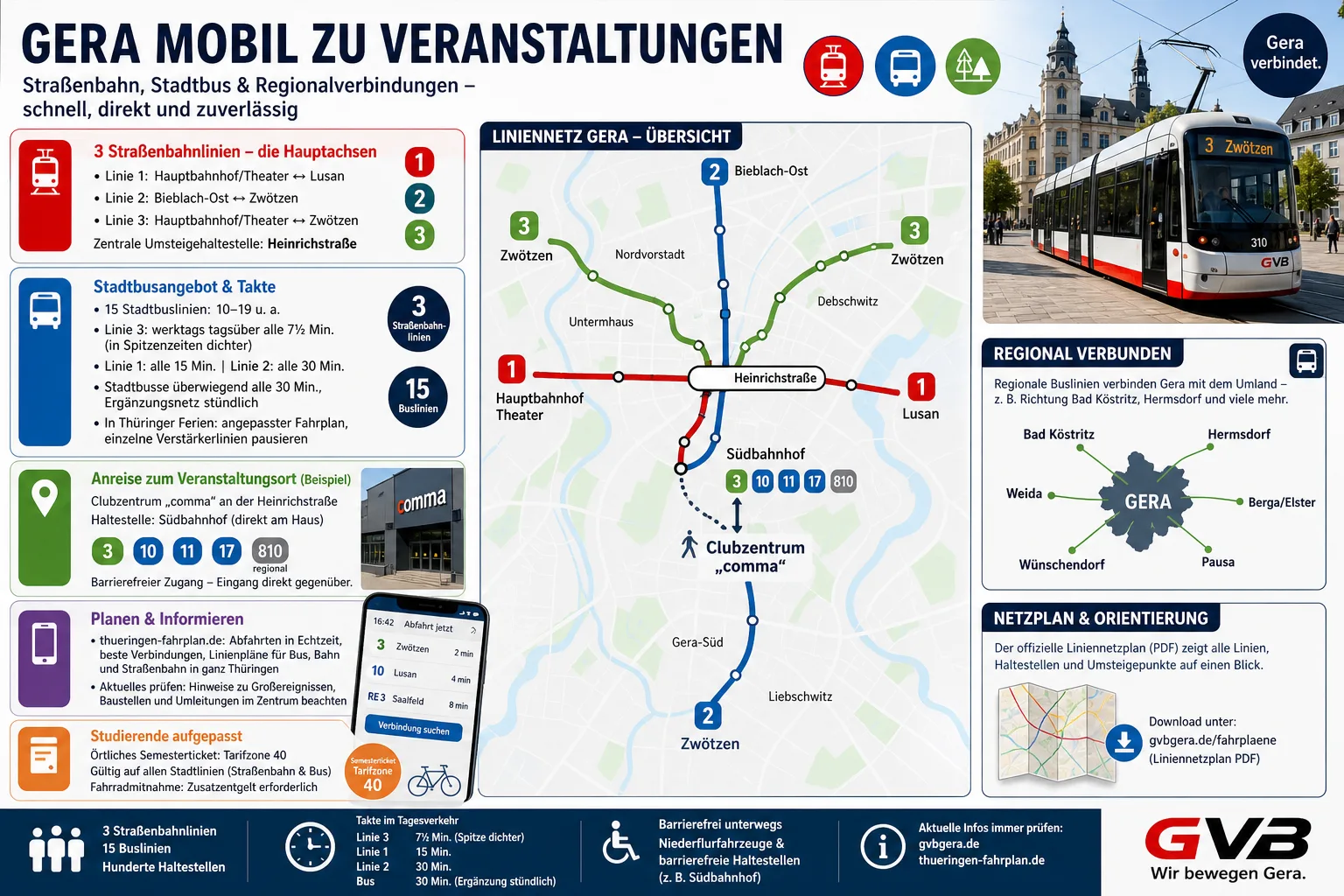
If you want to attend a future event in Gera (concert, theater evening, sports event, or club night), the basic strategy is almost always the same: You use one of the main tram axes to get to a central transfer point (often the main station or Heinrichstraße) and, if necessary, switch to a city bus for the last few minutes to the location.
To make this work reliably, you only need two things: a network map for orientation and a real-time timetable information for the specific departure. Both are provided by the responsible transport services in Gera/Thuringia (see sources at the end).
Tram: Main Axes and Stress-Free Transfers
The tram is typically the fastest connection through the city in Gera, as it bundles central axes and is well connected to important hubs. Particularly relevant for event visits are:
- Main station as an entry point for those arriving by train,
- Heinrichstraße as a frequent transfer point between lines,
- Stops in the vicinity of the city center and event clusters.
Which lines will actually take you to your destination and how frequent the intervals are can vary depending on the day of the week, time of day, holiday schedule, and construction sites. Therefore, rely on the current timetable information and the operators' notices for the event day (see section Planning).
Practical tip: For events with a fixed start time, plan a connection that gets you at least 15–20 minutes before the event to the vicinity of the location. This buffer covers short delays, the walk from the stop, and entry situations.
City Buses: Fine Distribution to Neighborhoods and Locations
Where there are no tracks, city bus lines take over the fine distribution. For many future events, the bus is especially crucial if:
- your starting point is in a residential area not directly on a tram line,
- you want to return late after the event and a direct bus connection is the shortest option,
- you prefer a more accessible route with fewer transfers.
Here too: Intervals and routes may change due to holiday schedules, detours, or construction. Check the connection in the real-time information on the day of travel and pay attention to disruption reports.
Example Route: To a Location Around Heinrichstraße/Südbahnhof
Many event venues benefit from being close to a transfer hub. If your future event takes place in the Heinrichstraße area or around the stops near the Südbahnhof, the journey is often uncomplicated, as several lines are within short distance.
How to proceed (for any starting point)
- Select starting stop: Take the nearest stop in your neighborhood or at the main station.
- Plan for the hub: Look for a connection that takes you to Heinrichstraße (or another central transfer point).
- Determine the last mile: From there, continue by tram/bus or walk the last few minutes, depending on the location's position.
- Plan your return trip in advance: Check the latest reasonable return connection before departure, especially if you don't leave immediately after the event ends.
If you are traveling with a wheelchair, walker, stroller, or luggage, it is also worthwhile to filter for accessible connections in the information (if offered) and keep transfers to a minimum. Whether a specific stop or vehicle is fully accessible may vary depending on the equipment; operator information is the most reliable source for this.
Planning: Network Map, Real-Time, and Notices in Special Situations
For event visits, not only the timetable is important, but also the question: Is it really running as planned right now? Two tools help you here.
1) Network Map (for Orientation)
An official line network map is ideal for understanding the structure: What axes are there, where are transfer points, and which stops are strategic for you? This is especially helpful if you often attend different future events in various districts.
2) Real-Time Timetable Information (for the Event Day)
On the day of the event, use timetable information that combines bus, tram, and regional services. Pay attention to:
- Actual times (real-time instead of just scheduled times),
- Notices about cancellations or changed departure platforms,
- Alternative connections in case your evening runs longer.
Notices in Case of Construction and Major Events
In case of closures, construction, or special traffic (e.g., for a larger future event with increased demand), line routes and connections may be adjusted. Therefore, check the current announcements from the transport services in Gera/Thuringia before departure.
Regional Arrival (Surrounding Area) & Students
Coming to Gera from the Surrounding Area
If you are coming to a future event in Gera from the surrounding area, the combination of regional transport (train/bus) and subsequent city transport is often the stress-free alternative to the car. Plan your return trip especially carefully: The later the event ends, the more important it is to choose a connection that remains realistically reachable.
Traveling with a Semester Ticket
Students should check before the event day where and when their semester ticket is valid (spatial validity, means of transport, times) and what conditions apply for bicycle transport. These details may vary depending on the university, tariff area, and contract. Reliable information is provided by the official ticket and tariff pages (see sources).
Practical Checklist for the Event Day
- Set start time: Plan so that you are near the location 15–20 minutes before it begins.
- Check real-time: Check actual times and notices shortly before departure.
- Reduce transfers: If unsure, rather choose a connection with one transfer instead of two.
- Secure return trip: Save (or remember) a later alternative in case you stay longer.
- Accessible route: If necessary, prefer connections with short walks and few stairs.
- Ticket ready: Have your ticket/Germany ticket/semester ticket ready before boarding.
Note: This article is a guide for getting to future events. The current information from the transport companies and associations is always binding.