Urban Transformation in Gera: New Neighborhoods & Projects
Urban Transformation in Gera: Which Projects Will Shape the City Center in the Coming Years
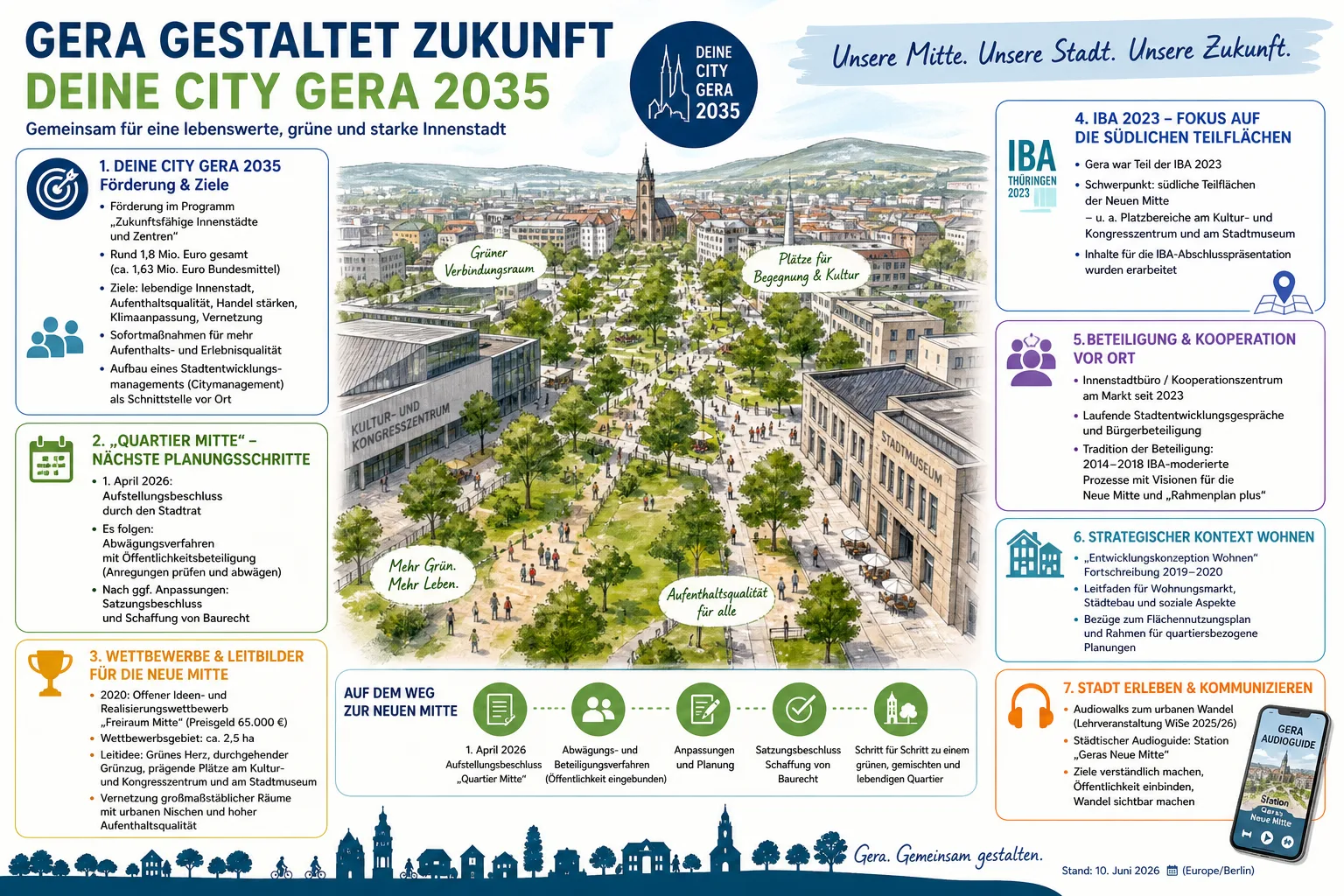
Gera is facing a phase in which central areas of the city center are to be reorganized, more greened, and used more intensively again. The focus is on a long-term city center program (under the guiding principle "Your City Gera 2035") and the development of the central area, which is being discussed as the "Quarter Center" or "New Center." This article classifies which steps are next, how participation typically proceeds, and what changes this may bring for everyday life, visitors, and the local economy.
What Urban Transformation in Gera Is About Now
The upcoming transformation mainly concerns three topics that must work together in the coming years:
- Urban Space and Open Space: more shade, trees, quality of stay, safe routes for walking and cycling, as well as areas for everyday life and events.
- Mix of Uses: Living, working, culture, services, and gastronomy should complement each other more so that the center remains lively throughout the day.
- Implementation and Governance: City and urban development management, owner and business dialogues, and transparent participation should make decisions comprehensible.
What matters less is a single construction project, but rather a bundle of planning, participation, and implementation modules that gradually take effect.
"Your City Gera 2035": What Can Be Specifically Expected Next
The guiding principle "Your City Gera 2035" stands for city center development that combines short-term improvements in public space with a longer-term vision. In the next phase, experience shows that three things matter:
1) Packages of Measures That Become Quickly Visible
In the coming months and years, interventions that achieve an effect with relatively little effort are particularly plausible: additional seating, targeted greening, better crossings, temporary uses of vacant spaces, and pilot projects that can later be converted into permanent solutions.
2) A Robust City Center Concept as a Basis for Decisions
So that investments and individual measures do not run in parallel, a concept with clear priorities is needed: Where should living be strengthened? Which axes and squares are key spaces? How are traffic, delivery zones, and quality of stay reconciled? Further coordination, workshops, and technical reviews can therefore be expected in the near future.
3) City and Urban Development Management as a Permanent Interface
For implementation, a contact point is important that mediates between administration, business, property owners, and the urban community. In the future, success will be measured by whether communication is reliable (clear responsibilities, regular updates, understandable decision-making paths) and whether participation is visibly incorporated into results.
Quarter Center / New Center: Which Planning Steps Are Decisive Next
The central development area in the city center is often described as the "New Center" and is planned as the "Quarter Center." For the coming years, it is less typical to have a single "everything-at-once" construction site, but rather a multi-stage process that brings together building law, open space, and mix of uses.
How the Process Usually Continues
- Deepening Urban Development Goals: Specification of guidelines such as mix of uses, proportion of green, path relationships, climate resilience, noise protection, and design of public space.
- Expert Reports and Reviews: Depending on the scope, e.g., traffic, noise protection, environmental concerns, rainwater/stormwater management, possibly contaminated sites and soil issues.
- Public and Authority Participation: Planning documents are displayed or made digitally accessible; comments can be submitted; the city must weigh these.
- Planning Law Resolutions: Once the weighing is complete, a development plan can be adopted as a statute. Only then does building law become reliable.
- Implementation in Stages: Usually, development, paths, and open spaces are prepared first; building components follow in sections.
For residents, it is especially important to know when participation windows are open (and how feedback is incorporated) and which quality criteria should apply to the quarter: shading and trees, safe cycling and walking paths, low-barrier access, good lighting, mix of uses, and open space design that also works in everyday life.
Open Space & Climate: What Will Matter for Green Corridors, Squares, and Everyday Quality in the Future
If a large inner-city area is to become a functioning urban component, much will be decided in the open space. For the next steps, these criteria are particularly relevant:
- Heat Protection and Shade: Trees, unsealed partial areas, and suitable materials reduce summer stress.
- Rainwater Management: Areas should be able to better absorb and drain heavy rainfall, for example through swales, infiltration trenches, or permeable surfaces where technically appropriate.
- Accessibility: Good surfaces, understandable path guidance, crossings without unnecessary obstacles.
- Multiple Use: Squares that allow both markets and events as well as quiet everyday use.
- Safety and Orientation: Lighting, sightlines, and clear spatial edges increase usability in the evening.
So that the open space is not only "beautiful" but also usable in the long term, it will also be crucial in the future how maintenance, cleaning, and seasonal adjustments (e.g., water, furniture, temporary uses) are organized.
Citizen Participation: How You Can Effectively Get Involved in the Coming Phases
For large city center projects, participation is most effective when it is concrete: not just "for or against," but with comprehensible comments on use, path guidance, safety, greenery, noise, quality of stay, and conflicts between traffic and stay.
In the next rounds of participation, the following are typically particularly helpful:
- Everyday Observations: Where are bottlenecks, where are crossings missing, where do conflicts arise between cycling and walking?
- Times and Target Groups: Which groups use the city center in the morning, afternoon, evening? Where is light, seating, weather-protected areas needed?
- Concrete Quality Suggestions: e.g., minimum shares of shade, safe school routes, quiet areas, play and exercise opportunities, secure parking for bicycles.
- Notes on Mix of Uses: Which offers are missing in the center? Which uses should not disturb each other (e.g., nightlife and quiet living)?
For a fair debate, it is also important to distinguish between short-term construction site burdens and long-term urban effects: construction phases are temporary, quality and structure last for decades.
Living & City Center: Why Additional Resident Frequency Will Change So Much in the Future
If more people live in the city center in the future (or existing residential areas are upgraded), effects arise that go beyond individual buildings:
- More Stable Demand: Retail, services, and gastronomy benefit from everyday customers, not just peak times.
- More Social Control: Busy paths and squares are often perceived as safer when they are used in a variety of ways.
- Less Need to Travel: Short distances can make everyday life easier if supplies, culture, and public transport are easily accessible.
So that living in the center works in the long term, noise protection, open space quality, safe routes, and a good mix of quiet and lively subspaces will play a central role in the upcoming planning and implementation phases.
What This Means for Retail, Gastronomy, and Owners in the Coming Years
For the local economy, urban redevelopment is often both an opportunity and a challenge. In the coming years, two factors will be particularly important:
1) Construction Site and Accessibility Management
When measures are implemented, reliable communication is crucial: route guidance, delivery zones, temporary signage, and clear information about construction phases reduce friction losses.
2) A Clear Profile of the City Center
In the long term, city centers that are not just shopping destinations but spaces for experience, culture, and everyday life will win. In Gera, success will be measured by whether the future spaces of the "Center" are designed to encourage people to stay: through greenery, good squares, attractive ground floor zones, and a program that lasts throughout the year.
Outlook: How to Recognize in the Future That Development Is on Track
In the coming years, progress can be seen in verifiable signals:
- Transparent Planning Status: understandable documents, clear time and process communication, comprehensible weighing of interests.
- Measurable Quality of Stay: more shade and greenery, better paths, more attractive squares, low-barrier access.
- More Mix of Uses: new or stabilized offers on ground floors, more living in the center, stronger coupling of culture and everyday life.
- Smooth Implementation: well-managed construction phases that keep the city center usable.
If these points come together, Gera can gradually densify, green, and enliven its city center without losing sight of acceptance and everyday suitability.