How Gera is Becoming a Smart City – Digital City
How Gera is Becoming a Smart City: Planned Projects, Data Platforms, and Participation
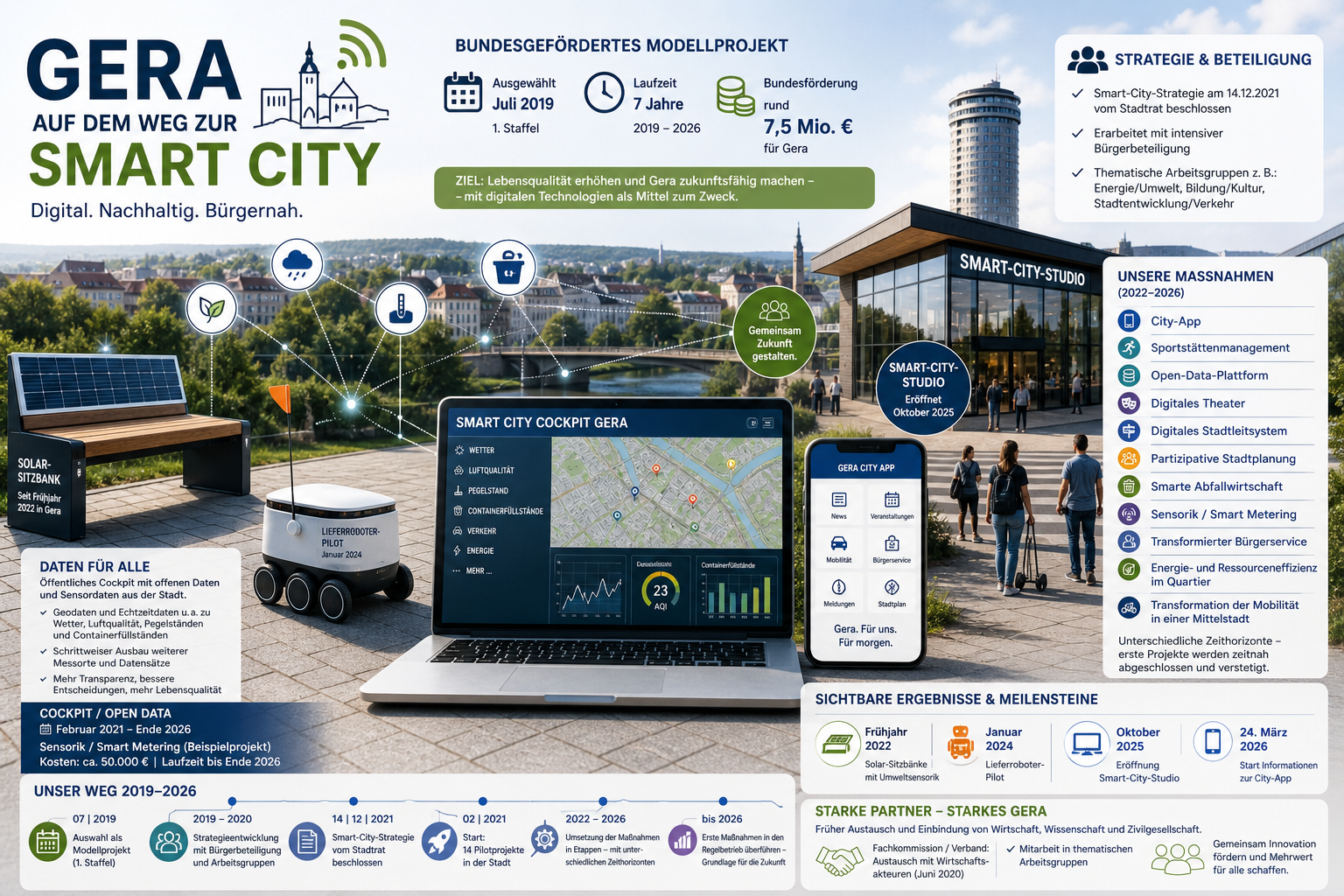
Gera pursues the goal of using digital technology to make everyday life easier, city planning more transparent, and resources more efficient. The focus in the future will be on open data, a Smart City cockpit, sensor-based applications, and new participation formats.
Model Project Smart City: Why Gera?
Gera is guided by the Smart City approach, as shaped in Germany especially by the federal program "Model Projects Smart Cities": Digital transformation should not be an end in itself, but should support sustainable urban development that is tangible for the people on site.
For Gera, this means above all in the coming years: expanding digital services in citizen service, better bundling reliable information for mobility and city life, making data more transparently usable, and establishing new forms of cooperation between city administration, urban society, business, culture, and education.
Strategy with Participation: How Gera Thinks Smart City
A Smart City is created not only through technology, but through clear goals, rules, and participation. For Gera, the focus in the future is therefore to link digital projects to comprehensible guidelines: Added value in everyday life, low barriers, data protection, IT security, and transparency.
The plan is to permanently anchor participation as a component of implementation – for example, through workshops, thematic working groups, and dialogue-oriented formats. This way, practical questions can be clarified at an early stage, such as:
- Which digital information helps with heavy rain and flood situations without creating alarmism?
- How can digital cultural offerings be designed to be accessible and understandable?
- Which online services at city hall really provide relief – and which still require personal advice?
The benefit of this approach will be higher acceptance, fewer isolated solutions, and a better fit between technology and urban everyday life.
From Pilot to Practice: Building Blocks of the Digital City (Outlook)
In Gera, several fields of action are to work together step by step. Not every topic has to result in its own app; what matters is that digital solutions are used where they demonstrably save time, provide orientation, conserve resources, or facilitate participation.
1) City App and Digital Information Channels
In the future, a central city app could bundle information on events, mobility, and city services. It will be crucial that the content is up-to-date, low-barrier, and accessible even without the app (e.g., as a web view).
2) Digital Citizen Service ("digital city hall")
A focus will likely be on online services that reduce trips and waiting times: digital applications, status information, secure document transmission, and understandable step-by-step processes. Data protection and information security should be planned from the outset.
3) Open Data as a Basis for Transparency and Innovation
An open data platform can in the future provide municipal data in a structured way so that administration, science, local businesses, and civil society initiatives can build on it – for example, for visualizations, analyses, or new applications. Important are clear data licensing, understandable metadata, and regular maintenance of the datasets.
4) Smart Waste Management and Infrastructure-Based Sensors
Sensors on containers or infrastructure can in the future report fill levels or conditions and thus improve routes, maintenance, and resource use. The added value arises especially when data is reliable, responsibilities are clearly regulated, and the evaluation supports concrete decisions.
5) Digital Cultural and Educational Offerings
In the coming years, digital formats can complement culture and education, for example through low-barrier information offerings, hybrid mediation formats, or digital additional content. The claim remains: Digital offerings should expand access, not replace on-site visits.
6) Participatory Urban Planning
Digital participation tools (e.g., map feedback, online consultations, traceable documentation) can make urban planning more transparent. The goal is to make participation more accessible and to integrate feedback transparently into the planning process.
Smart City Cockpit, Open Data, and Sensors: Data That Will Become Visible in the Future
A Smart City cockpit is conceivable as a central interface in which selected, non-personal city information is bundled and displayed. Depending on the data situation, for example, environmental measurements, weather information, or infrastructural status data could be visualized in the future.
For such systems to build trust, they should transparently indicate in the future:
- Which data sources are used and how often they are updated
- Which data is published openly – and which is not, for good reasons
- What quality limits (measurement accuracy, outages, gaps) exist
A meaningful application framework exists where data supports concrete decisions – for example, in resource planning, targeted maintenance, or in the information situation in the event of an incident. At the same time, for safety-critical situations, digital displays should always be supplemented by established official warning and information channels.
From Solar Bench to Living Lab: Where Smart City Can Become Tangible in the Urban Landscape
Smart City only becomes tangible for many when digital infrastructure becomes visible in public spaces – for example, through networked information points, charging and recreation offers, or sensor-based applications that show a clear benefit (e.g., better orientation or more efficient processes).
Just as important as the technology is a place or format where questions can be clarified: What is being collected? What is it for? How can people participate? Such dialogue spaces help to reduce fears of contact and to shape change as a joint learning process.
Societal Impact: What Smart City Can Mean for Gera in the Coming Years
Digital transformation can connect several levels for Gera in the future:
- For residents: better bundled information, lower-barrier access to services, and new participation opportunities – especially for people who rarely attend in-person appointments.
- For the local economy: new opportunities for IT and infrastructure services as well as application fields for data-based solutions, provided there are open interfaces, clear standards, and reliable responsibilities.
- For culture and education: additional access and hybrid formats that can expand reach and participation.
- For the administration: more data-informed processes, greater traceability of decisions, and more efficient processes – with a simultaneous obligation to data protection, IT security, and understandable communication.
The key to success is that benefits, limitations, and protective measures are openly stated – and that analog alternatives remain where they are needed.
Outlook: How Gera's Digital Future Can Continue to Unfold
In the coming years, it will become clear which projects in Gera will sustainably transition into regular operation. A gradual expansion is realistic: first the basics (data, standards, responsibilities), then user-oriented applications, followed by scaling and consolidation.
For Smart City development to remain viable in the long term, three factors are particularly important: reliable data quality, clear data protection and high IT security, and genuine user orientation – that is, solutions that work in everyday life and are explained in an understandable way.