
Marcel van Eeden
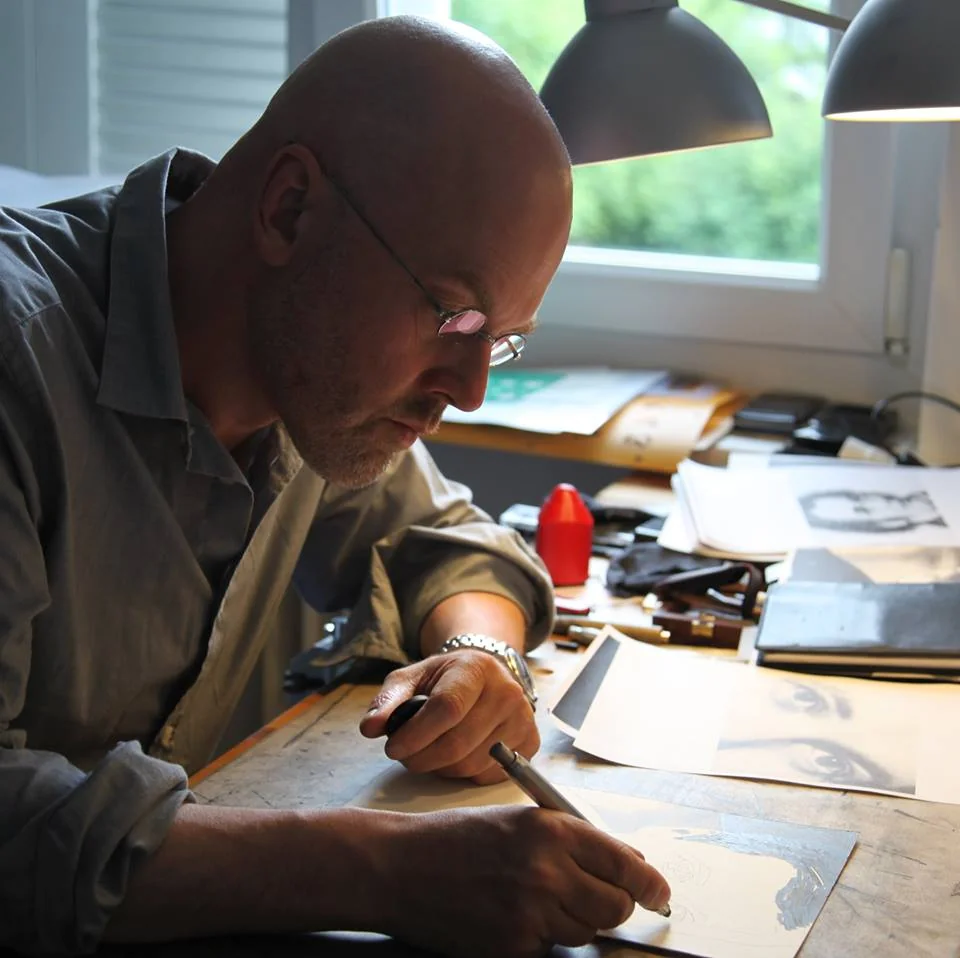
Image from Wikipedia
Image from Wikipedia
Marcel van Eeden – The Master of Black Imagery
An artist between noir aesthetics, image research, and invented memories
Marcel van Eeden, born on November 22, 1965, in The Hague, is one of the most distinctive Dutch draftsmen and painters of his generation. His work revolves around time, memory, and the construction of reality, unfolding an unmistakable visual language that blends film noir sensibility, historical research, and poetic montage. Van Eeden lives and works in Zurich and The Hague; he gained international recognition, notably through his contribution to the Berlin Biennale in 2006. ([de.wikipedia.org](https://de.wikipedia.org/wiki/Marcel_van_Eeden))
Biographical background and academic influence
Van Eeden studied painting at the Koninklijke Academie van Beeldende Kunsten in The Hague from 1989 to 1993. This training lays the foundation for an artistic development that regards drawing and painting not as rigid opposites, but as related processes with their own tonalities and narrative powers. Early on, he exhibited an interest in serial orders, visual archives, and a form of image production that relies not on spontaneous gestures but on precisely composed atmospheres. ([de.wikipedia.org](https://de.wikipedia.org/wiki/Marcel_van_Eeden))
Characteristic of his works is the impression of film noir: dark scenes, strong black-and-white contrasts, almost photorealistic image spaces, and a tension that arises from the juxtaposition of suggestion and precision. The works appear as fragments of a larger, never fully decipherable narrative arc. This is precisely where van Eeden's art derives its fascination: each piece opens a story that simultaneously eludes full grasp. ([de.wikipedia.org](https://de.wikipedia.org/wiki/Marcel_van_Eeden))
The breakthrough: series, characters, and invented biographies
A central moment in van Eeden's artistic development is his shift to large-scale series. From 2004/2005 onward, he began consolidating drawings into complex cycles, often triggered by literary texts or recurring characters. The first major block was the 150-piece series K. M. Wiegand. Life and Work from 2006, in which he translates the biography of a historically verified botanist into a fictional narrative. This approach transforms his art into a form of visual literature, where archival material, storytelling, and imagination merge. ([de.wikipedia.org](https://de.wikipedia.org/wiki/Marcel_van_Eeden))
In later series such as Celia, The Archeologist. The Travels of Oswald Sollmann, and The Death of Matheus Boryna, van Eeden also works with characters whose life stories are composed of real and invented elements. In Witness for the Prosecution, he brought several of these protagonists together, condensing his method of narrative linkage. His art thus evolves not linearly but in chapters, motifs, and repetitions—forming a body of work with great inner consistency. ([de.wikipedia.org](https://de.wikipedia.org/wiki/Marcel_van_Eeden))
The "Encyclopedia of My Death" as an artistic leitmotif
Van Eeden himself describes a significant part of his oeuvre as a project of an "Encyclopedia of My Death." This refers to his consistent engagement with events, images, and sources that precede his birth in 1965. He utilizes photographs, exhibition catalogs, fragments from newspapers and magazines, fabric samples, and other historical references to create his own sense of time, in which the past is not merely documented but aesthetically rearranged. ([de.wikipedia.org](https://de.wikipedia.org/wiki/Marcel_van_Eeden))
This strategy makes his work an exploration of how history becomes visible at all. The image panels and drawing series create an atmosphere of historical distance without seeming cold; they are full of suspense but never merely illustrative. Van Eeden combines rigorous research with high painterly sensitivity, and therein lies the quality of his artistic authority. ([de.wikipedia.org](https://de.wikipedia.org/wiki/Marcel_van_Eeden))
Exhibitions, international presence, and current projects
Van Eeden has been internationally present for many years. His exhibition history spans from the 4th Berlin Biennale in 2006 to projects in Hamburg, Zurich, Paris, Toronto, Amsterdam, Vienna, New York, and other art centers, culminating in more recent presentations such as Paris, January 1926 in Paris, Blockbuster in Amsterdam, or The Villa in Winterthur. The CV page of his official website shows how consistently he has anchored his bodies of work in large institutional and gallery contexts. ([marcelvaneeden.nl](https://www.marcelvaneeden.nl/cv))
Current and recent projects include The Villa in Winterthur, Der heimliche Kaiser in Braunschweig and Goslar, Hans Thoma – Between Poetry and Reality in Freiburg, and Oranges Grow Without Thorns in Schwetzingen, scheduled for 2024 and 2025. His recent presence underscores that van Eeden should not be regarded solely as an artist of the past, but as an active voice in the current discourse on drawing, memory, and historical image production. ([marcelvaneeden.nl](https://www.marcelvaneeden.nl/cv?utm_source=openai))
Discography? No – a curated work between drawing, painting, and books
As a visual artist, Marcel van Eeden does not have a discography in the musical sense, but his work follows a similarly structured logic of cataloging, sequencing, and recurring motifs. Here, series, books, exhibition publications, and bodies of work are especially important. His official pages refer to sections like Works, Bibliography, and Books, highlighting the character of a long-term constructed artistic archive. ([marcelvaneeden.nl](https://www.marcelvaneeden.nl/))
In critical reception, the series Celia, The Hotel, The Zurich Trial, The Darkest Museum in the World, and Drawing Rooms are particularly emphasized. His work navigates between drawing, painting, photography, and book art, and this openness to media has strengthened his position in contemporary international art. Exhibitions and publications do not merely serve as accompanying material for van Eeden, but as integral parts of his artistic system. ([marcelvaneeden.nl](https://www.marcelvaneeden.nl/cv))
Critical reception, awards, and cultural influence
The art press has early described van Eeden as an artist who shapes a unique, often unsettling logic of memory from foreign fragments. The Tagesspiegel emphasized in the 2000s his ability to condense images into an artful diary form; later reviews highlighted the noir-like visual impact, the artificial biographies, and the narrative complexity of his series. His official artist page also documents accolades such as the Hans Thoma Prize 2023, the Ouborg Prize 2013, and the Prix de Dessin from the Fondation Daniel et Florence Guerlain in 2011. ([tagesspiegel.de](https://www.tagesspiegel.de/kultur/der-zeichenmaschinist-1492693.html?utm_source=openai))
His cultural influence is evident not only in museum acquisitions and international collections but also in his teaching activities. Van Eeden is a professor of drawing and painting at the State Academy of Fine Arts Karlsruhe; his official CV page also states that he has been the rector since 2021. Thus, he shapes not only his own oeuvre but also the artistic education of a new generation, lending his name weight far beyond solo exhibitions. ([marcelvaneeden.nl](https://www.marcelvaneeden.nl/cv?utm_source=openai))
Style and artistic signature
Van Eeden's style thrives on the tension between control and uncertainty. His works are carefully composed, often created in small formats, and yet they open up an enormous narrative-aesthetic field. The tonal values carry the composition, not just the line; it is here that his painterly approach becomes apparent, merging drawing, painting, and image archiving into a single visual thought process. ([de.wikipedia.org](https://de.wikipedia.org/wiki/Marcel_van_Eeden))
Engaging with Marcel van Eeden means experiencing art as a concentrated narrative machine. His images resist quick resolutions and reward close observation with atmospheric depth, historical resonance, and intellectual tension. It is precisely this blend of formal ambition, narrative density, and analytical precision that makes him one of the most interesting draftsmen in contemporary European art. ([de.wikipedia.org](https://de.wikipedia.org/wiki/Marcel_van_Eeden))
Conclusion: Why Marcel van Eeden remains relevant today
Marcel van Eeden is exciting because he understands the image not as a snapshot but as a space for thought. His art intertwines past and fiction, research and imagination, book and exhibition, creating an unmistakable language with high recognition value. Those who want to experience contemporary drawing in its most demanding form should follow van Eeden not only in museums but also in the exhibition spaces of the present. ([marcelvaneeden.nl](https://www.marcelvaneeden.nl/cv))
His work invites a closer look, a quest for connections, and a rethinking of the power of the image. Especially in live settings, during direct encounters with the series, the full impact of this quiet, highly concentrated art unfolds. Marcel van Eeden is an artist who endures because his images do not merely tell history, but make it visible as an open question. ([marcelvaneeden.nl](https://www.marcelvaneeden.nl/cv?utm_source=openai))
Official channels of Marcel van Eeden:
- Instagram: no official profile found
- Facebook: no official profile found
- YouTube: no official profile found
- Spotify: no official profile found
- TikTok: no official profile found
Sources:
- Marcel van Eeden – Official Website
- Marcel van Eeden – CV
- Marcel van Eeden – Exhibitions
- Wikipedia: Marcel van Eeden
- Kunstmuseum Den Haag – De Ouborg Prize 2013
- Drawing Room – Drawing Biennial 2019: Marcel van Eeden
- Der Tagesspiegel – The Drawing Machine
- Der Tagesspiegel – When I Was Once Dead
- Marcel van Eeden – News
- Marcel van Eeden – Bibliography
Upcoming Events
Art Break: Marcel van Eeden's Approach to Photography
Tour: Marcel van Eeden
Tour: Marcel van Eeden
Tour: Marcel van Eeden
Pause of Art in French: Voices of Algiers
Tour: Marcel van Eeden
Exhibition of Marcel van Eeden at the Augustiner Museum
CANCELED: Tour: Marcel van Eeden
Tour: Marcel van Eeden