Matthias Deutschmann
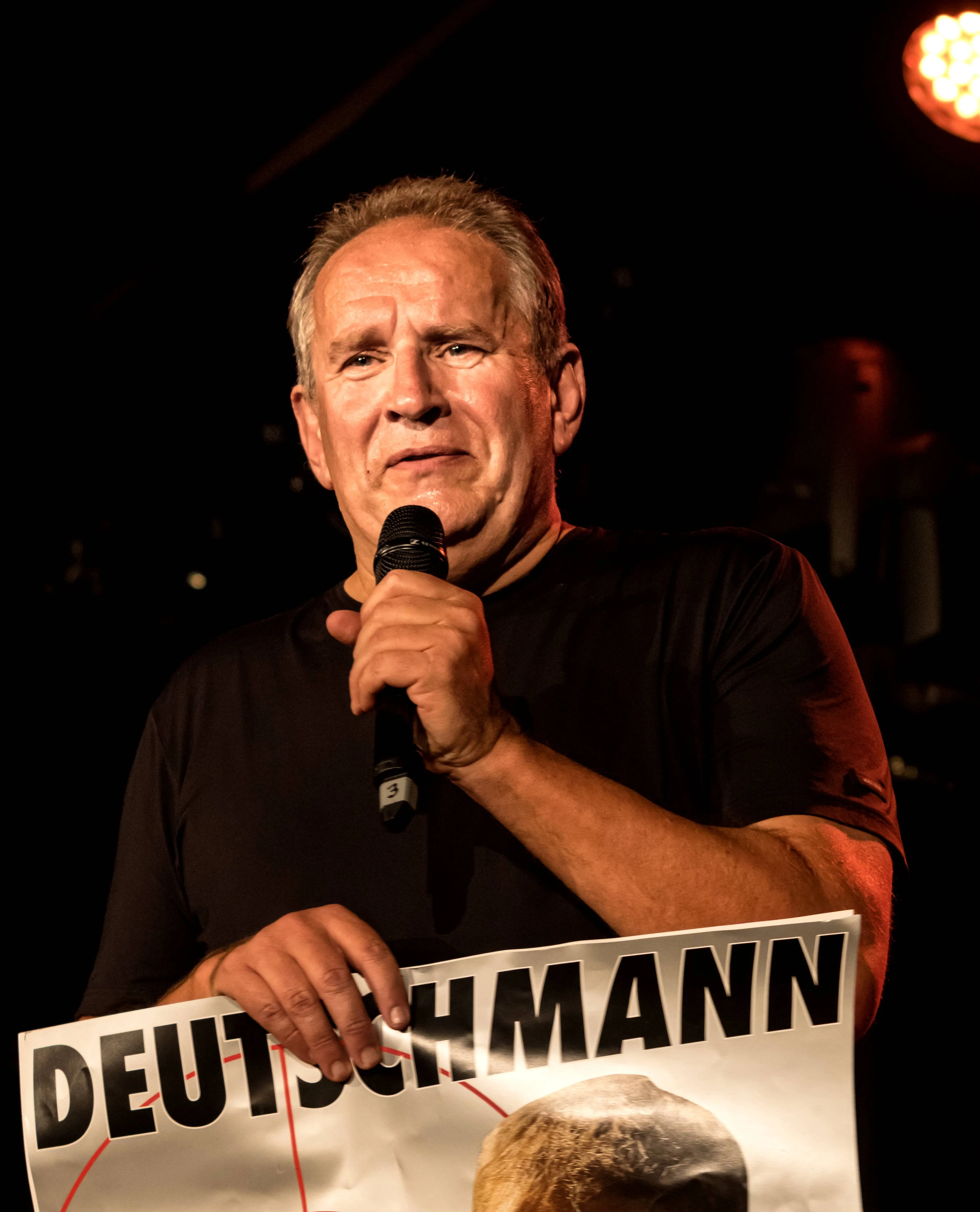
Image from Wikipedia
Image from Wikipedia
Matthias Deutschmann: Political Cabaret with Cello, Stance, and Razor-Sharp Precision
A cabaret artist who transforms thought, contradiction, and stage presence into a unique art form
Matthias Deutschmann is one of those German cabaret artists who have turned the punchline stage into a place of intellectual friction. Born on September 16, 1958, in Betzdorf, he moved to southwestern Baden in 1973, began studying in Freiburg in 1977, and increasingly gravitated towards cabaret from 1979, initially in groups and later as a distinguished solo artist. His trademark is the cello, which he uses as a lyrical counterpoint to his often sharp political barbs. ([marionwaechter.de](https://marionwaechter.de/kuenstler/matthias-deutschmann/))
Deutschmann represents political cabaret that does not merely rely on current events, but instead focuses on analysis, irony, and historical depth. His career unfolds against the backdrop of stages, debates, and societal upheavals: from Freiburg's student cabaret through early solo programs to current evenings that build on authority, experience, and linguistic precision. This is precisely where his unique position in the realm of German cabaret lies. ([marionwaechter.de](https://marionwaechter.de/kuenstler/matthias-deutschmann/))
Biography: From the Southwest to the Grand Cabaret Stage
Matthias Deutschmann's artistic development did not begin in a pop or music scene, but rather within the political culture of cabaret. After moving to southwestern Baden and studying in Freiburg, a workshop with Sammy Drechsel from the Munich Laugh and Shoot Society opened his eyes to the professional form of the genre. Influenced by Hanns Dieter Hüsch, Kay Lorentz, and Wolfgang Neuss, he learned from living examples of a satirical tradition that prioritizes stance over cheap theatrics. ([marionwaechter.de](https://marionwaechter.de/kuenstler/matthias-deutschmann/))
Early on, Deutschmann combined text, timing, and musical structure into a distinctive style. Between 1980 and 1983, he worked in the student cabaret Schmeißfliege, in 1984 as a writer for the Düsseldorf Kom(m)ödchen, and in 1985 he followed with "Blinder Alarm" alongside the Under Cover Combo. In 1986, his first solo show, "Eine Schnauze voll Deutschland," debuted, followed in 1987 by "Einer flog über’s Grundgesetz." These stages mark the transition from ensemble cabaret to an autonomous stage figure. ([marionwaechter.de](https://marionwaechter.de/kuenstler/matthias-deutschmann/))
Career Path: Between Berlin, Freiburg, and the Political Present
In 1989, Matthias Deutschmann moved to Berlin and expanded his repertoire to include solo programs, returning to Freiburg in 1991. These relocations also reflect his artistic movement: away from mere allegiance to scene, towards a voice that positions itself as a commenting entity in the political space. In the late 1980s, he also supported the Green Party's election campaign tour "Winterzauber" alongside Rio Reiser, Wolf Biermann, Udo Lindenberg, Wolfgang Niedecken, and Georg Ringsgwandl. ([marionwaechter.de](https://marionwaechter.de/kuenstler/matthias-deutschmann/))
The programs consistently showcase a line of political intensification: "Solo für Deutschmann," "Das kleine Fegefeuer," "Wenn das der Führer wüsste," "Staatstheater," "Wie sagen wir’s dem Volk?," "Mephisto Consulting," and currently, "Propaganda à la carte." His contemporary work springs from long-term observation of power, language, and public discourse. This is where his stage presence gains that authority that has become rare in cabaret. ([marionwaechter.de](https://marionwaechter.de/kuenstler/matthias-deutschmann/))
Current Projects: “Propaganda à la carte” as a Keen Comment on the Times
Currently, "Propaganda à la carte" shapes Matthias Deutschmann's artistic work. The program texts pose the question of whether political cabaret still finds enough friction in an overstimulated present, responding with a blend of satire, analysis, and deliberate counterpoint. The production premiered in October 2025 at Tollhaus Karlsruhe and will be performed on numerous stages throughout 2026 and into January 2027, including Buttstädt, Freiburg, Düsseldorf, Hamburg, Bremerhaven, the Munich outskirts, and Mainz. ([marionwaechter.de](https://marionwaechter.de/kuenstler/matthias-deutschmann/))
Recent press texts also emphasize that Deutschmann understands his programs as political thinking on an open stage. The official website describes him as a high-caliber cabaret artist with extensive stage experience, particularly showcasing his strengths on topics such as war and peace. Thus, he does not limit himself to current political effects, but works on a form of contemporary diagnosis that relies on experience and structure. ([matthiasdeutschmann.de](https://matthiasdeutschmann.de/?utm_source=openai))
Discography and Documented Programs: The Artistic Trail of a Tireless Satirist
In a narrower sense, Matthias Deutschmann is not a classical musician with studio albums and chart singles. His "discography" therefore consists primarily of documented cabaret programs, stage recordings, and thematic solo evenings, forming a historical narrative of political satire. Key milestones include "Blinder Alarm" (1985), "Eine Schnauze voll Deutschland" (1986), "Einer flog über’s Grundgesetz" (1987), "Solo für Deutschmann" (1990), "Wenn das der Führer wüsste" (1993), "Finalissimo" (1999), "Staatstheater" (2004), "Die Reise nach Jerusalem" (2007), "Deutsche, wollt ihr ewig leben?" (2010), "Wie sagen wir’s dem Volk?" (2015), "Notwehr für Alle!" (2020), "Mephisto Consulting" (2022), "Wem die Stunde schlägt – 60 Minuten mehr Demokratie wagen" (2024), and "Propaganda à la carte" (2025). ([marionwaechter.de](https://marionwaechter.de/kuenstler/matthias-deutschmann/))
There is no separate chart history similar to that of pop or rock artists; instead, successes lie in accolades, revivals, tour activities, and a solid establishment within the German cabaret scene. The overview reveals a remarkable continuity: Deutschmann responds to political shifts without leveling his language. This makes his program list a kind of chronicle of the Federal Republic in the mode of satire. ([marionwaechter.de](https://marionwaechter.de/kuenstler/matthias-deutschmann/))
Style, Language, and Musical Signature
Deutschmann's style thrives on an unusual combination of intellectual sharpness and musical tension-building. The cello is more than a prop; it serves as a dramatic tool, lyrical break, and atmospheric commentary all at once. In the texts from his agency, this interplay of “toxic punchlines” and musical counterpoint is highlighted, giving his performances a distinctive dynamic between speech, rhythm, and resonance. ([marionwaechter.de](https://marionwaechter.de/kuenstler/matthias-deutschmann/))
The press also describes this working method as intellectual, subtle, and artisan-like in precision. The agency site quotes, among others, the Süddeutsche Zeitung characterizing his work as “satirical craftsmanship” and pointing to press voices that emphasize wit, depth, and extensive knowledge. Other voices stress that Deutschmann particularly shines when he addresses major themes and avoids simple effects. ([marionwaechter.de](https://marionwaechter.de/kuenstler/matthias-deutschmann/))
Awards, Recognition, and Cultural Influence
His work has received multiple awards: in 1992, Matthias Deutschmann won the German Cabaret Prize, in 1994 the German Small Arts Prize, in 2007 the Leipzig Löwenzahn, in 2014 the Baden-Württemberg Small Arts Prize, and in 2021 the Lasker Prize for achievements in the cultural field. These accolades mark not only success but also the long-term relevance of an artist who has shaped political cabaret over decades. ([kulturelle-vereinigung.de](https://kulturelle-vereinigung.de/wp-content/uploads/2025/06/Programmheft_2025_26.pdf))
The cultural influence lies primarily in the consistency of his stance. Deutschmann combines analysis with risk, education with stage energy, and current affairs with historical awareness. His programs function as precisely constructed comments on the present, in which language itself becomes a political instrument. Precisely for this reason, he remains compelling for all those who view cabaret not as a marginal phenomenon but as a serious form of public art. ([marionwaechter.de](https://marionwaechter.de/kuenstler/matthias-deutschmann/))
Conclusion: An Artist for Attentive Ears and Alert Minds
Matthias Deutschmann is an exception in German-language cabaret: an artist with biography, work, stance, and an unmistakable stage presence. His blend of political analysis, linguistic precision, and musical counterpoint makes every performance a concentrated experience. Anyone looking for clever satire, pointed contemporary diagnoses, and a strong live stage format should definitely experience him. ([marionwaechter.de](https://marionwaechter.de/kuenstler/matthias-deutschmann/))
Official Channels of Matthias Deutschmann:
- Instagram: No official profile found
- Facebook: No official profile found
- YouTube: No official profile found
- Spotify: No official profile found
- TikTok: No official profile found
Sources:
- Matthias Deutschmann – Official Website
- Agency Marion Wächter – Artist Page for Matthias Deutschmann
- Wikipedia – Matthias Deutschmann
- Cultural Association – Program 2025/26 with Press Reviews and Awards
- SWR Culture – Studio Guest Matthias Deutschmann
- Deutschlandfunk – Cabaret Artist Matthias Deutschmann
- Matthias Deutschmann – Imprint
Upcoming Events
Matthias Deutschmann - Propaganda à la carte - Cabaret