
Gera
Nicolaistraße 24, 07545 Gera, Deutschland
Botanical Garden Gera | Opening Hours & Events
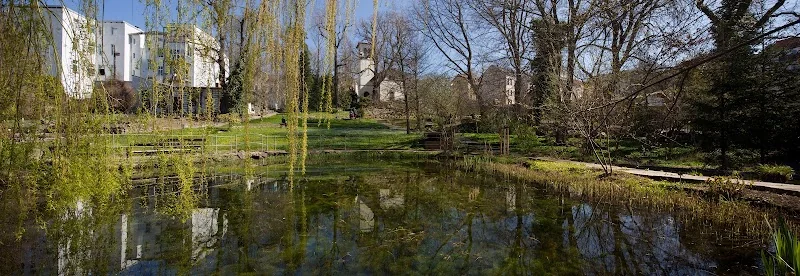
The Botanical Garden Gera is a small but surprisingly dense green oasis in the center of the city. On just 0.7 hectares, the facility combines historical garden culture, two natural springs, a late classical garden house with a tower, and a compact overview of the plant world of East Thuringia. The garden was created from a civic foundation by Walther Ferber in 1897; its origin lies in an idea of education and recreation, not in a purely ornamental facility. You can still feel this today: The Botanical Garden feels like a walkable textbook, where paths, pond areas, old trees, meadows, and structured planting areas lie closely together. Therefore, those who walk through the facility do not simply experience a city park, but a place where nature, science, and urban history intertwine. Additionally, its location almost in the city center makes the garden particularly attractive for short breaks, conscious walks, and small discovery tours. The official city website describes the facility as a garden with around 1000 known and almost forgotten plants as well as seven habitats presented in a small space. ([gera.de](https://www.gera.de/tourismus-freizeit-kultur/natur-geniessen/parks-gaerten-friedhoefe/botanischer-garten))
Opening Hours, Admission, and Visitor Service
Those who wish to visit the Botanical Garden Gera will find very clear and current service information on the official pages. The garden season is indicated there until October 31, 2026. During this period, the garden is open Monday to Friday from 8:00 AM to 6:00 PM, and on Saturdays, Sundays, and public holidays from 9:00 AM to 6:00 PM. Additionally, it is pointed out that groups can also be registered outside of regular opening hours by arrangement. This is practical for visitors, as the garden is suitable not only for spontaneous walks but also for organized tours or small excursions. The visitor page also consolidates address, contact, and information in a compact overview and refers to the visitor service of the Natural History Museum Gera, to which the Botanical Garden is organizationally affiliated. It is noticeable that while the official pages announce the topic of admission prices, they do not specify a concrete price list. Therefore, one should check directly with the city of Gera for current pricing information or inquire by phone or email. This fits well with the character of the garden: It is less about a classic ticket location and more about a public nature and educational space with clear rules, fixed seasonal times, and a high proportion of self-discovery. Those planning their visit can thus very well adjust the time to the weather, season, and personal interest. Especially in spring, when the season begins, and in summer, when events are added, it is particularly worthwhile to take a look at the current information. ([gera.de](https://www.gera.de/tourismus-freizeit-kultur/museen/botanischer-garten/besucherservice))
Access, Parking, and Accessibility in the Botanical Garden Gera
The location of the Botanical Garden Gera is very convenient for an inner-city garden, as several access routes are described briefly and clearly. Those arriving by train can reach the garden from Gera Central Station in about 1.2 kilometers on foot. Alternatively, you can use tram line 1 towards Zwötzen to the Heinrichstraße stop and then walk about 0.6 kilometers from there. The stops of tram line 3 at Sorge/Markt or Leipziger Straße are even closer, with about 0.5 kilometers of walking distance. The bus lines 10, 11, 17, 19, and 26, which stop at Schillerstraße, are also particularly convenient; from there, it is only about 0.2 kilometers. For those arriving by car, the city mentions paid parking spaces directly around the Salvatorkirche, the parking garage Markt/Rathaus in Nicolaistraße, and the parking lot Am Markt in Stadtgraben 12. Additionally, there is a parking space for coaches in Nicolaistraße at the height of the former Goethe-Gymnasium Rutheneum. This combination of train, tram, bus, and car makes the visit relatively uncomplicated, even though the garden is located in the middle of the city. At the same time, it is important: The Botanical Garden Gera is not barrier-free. This note is clearly repeated on several official pages. Those with limited mobility should definitely consider this when planning and possibly contact in advance. For everyone else, the path is short, orientation is simple, and the location is central enough to combine the visit with a city stroll. This is particularly pleasant when one does not view the garden as an isolated destination but as part of a larger route through the city center. ([gera.de](https://www.gera.de/tourismus-freizeit-kultur/museen/botanischer-garten/besucherservice))
Events, Plant Fair, and Harvest Festival
The Botanical Garden Gera is not only a place for quiet walks but also a small stage for seasonal events. The official event page lists the plant fair for enthusiasts in the Botanical Garden Gera on July 12, 2026, from 10:00 AM to 5:00 PM. It also lists the program for the museum night on August 22, 2026, with tours of night-blooming plants in twilight and late light capture. This mixture fits well with the identity of the garden: during the day, a botanical learning place, in the evenings during special occasions, an experiential space with its own atmosphere. An earlier city contribution to the season opening additionally shows how strongly the garden is supported by the sponsoring association and the public of Gera. It describes the opening event for the garden season, as well as the new bridge in the water area, which creates a better path and new observation opportunities for shore plants and aquatic animals between the two ponds. In the same contribution, the next highlights are mentioned as the plant fair for enthusiasts and the harvest festival with fruit and mushroom exhibitions. This makes it clear that the Botanical Garden in Gera is more than a static plant collection: It is a place with recurring events, changing themes, and a community character that regularly brings visitors back. Especially for people looking for botanical special events, plant markets, season starts, or small nature events, this is an important signal. The garden thus offers not only tranquility but also a program, and in a form that matches the size of the facility: personal, manageable, and close to nature. ([gera.de](https://www.gera.de/tourismus-freizeit-kultur/museen/botanischer-garten/veranstaltungen))
History of the Botanical Garden Gera
The history of the Botanical Garden Gera is closely linked to the industrial development of the city and civic engagement. Gera was a very successful industrial metropolis of the textile and mechanical engineering industry in the 19th century. In this environment, foundations for social, cultural, and educational purposes were established. Walther Ferber, a textile manufacturer from a family with a significant mineral collection, made his garden property available for public education and recreation after his death in 1895; the city accepted the foundation and entrusted the development of the Botanical Garden to a commission of teachers, gardeners, and botanists in 1897. Teacher Robert Leube designed a garden concept that was meant to vividly illustrate the plant world of East Thuringia. The garden was intentionally conceived as an educational garden, not merely as an ornamental piece. Early on, a small-scale mosaic of habitats such as deciduous forest, shrub forest, field margin, meadow, stream, and pond emerged. From 1909 to 1913, Gotthold Hahn took over the management and focused on species richness and botanical peculiarities, such as wild roses. Under him, the first plant systematic facility as well as areas for useful plants and an alpine garden were added. Later, more emphasis was placed again on school biological tasks, for example, under Gustav Kohs, Dr. Erich Stengel, and Heinz Braun. Braun expanded the garden with a mushroom collection, bird protection station, terrarium, weather station, teaching places, panels, signage, and even a botanical exhibition. An important turning point occurred in 1947 with the merger of the Botanical Garden with the city museum, which later evolved into the Natural History Museum. Since the opening of a permanent exhibition on the landscape area of East Thuringia in 1984, this connection has become even stronger in content. This historical development explains why the Botanical Garden Gera remains both a place of education and a space for walking to this day. ([gera.de](https://www.gera.de/tourismus-freizeit-kultur/museen/botanischer-garten))
Garden Concept, Habitats, and Plant Diversity
The garden concept of the Botanical Garden Gera is the actual key to understanding the facility. The city explicitly describes the permanent exhibition not as a classic exhibition but as a garden concept that changes with the seasons. The garden is now located almost in the center of Gera, below the Ronneburger Höhe with the Ferber Tower, on a west-facing slope at about 225 meters above sea level. The area is favored by two springs. The property covers only 3/4 hectare but appears surprisingly diverse due to its clear structure. The basic form of the Ferber garden facility, laid out in the English landscape style, is still recognizable: old tree stock, winding path system, and the late classical garden house with tower built in 1864 shape the picture. The garden summarizes the plant world of the landscape structure of East Thuringia. More than 2000 species of ferns and flowering plants are found in this area, and about 400 wild species of East Thuringia are currently displayed in the Botanical Garden itself. Seven selected habitats are exemplarily presented with their characteristic plant communities in a small area. These include, among others, semi-dry grasslands, wet meadows, deciduous forests, and other typical site forms. The facility thus does not simply show individual attractive flowers but entire ecological contexts. This is particularly vivid in spring: In the deciduous forest, wood anemones, hollow-leaved corydalis, and liverworts bloom, while in the moist areas along the diverted spring stream, strong populations of wild garlic develop. In the coniferous forest area, typical species such as male ferns and lady ferns appear, reflecting the composition of spruce and pine forests in East Thuringia. This is complemented by shrubs, culinary herbs, medicinal and useful plants, as well as a geological teaching wall from 1898. The result is a garden that remains a teaching collection, landscape image, and nature experience in a small space. ([gera.de](https://www.gera.de/tourismus-freizeit-kultur/museen/botanischer-garten/gartenkonzept))
Visitor Tips, Rules, and Conclusion for Your Walk
Those who want to experience the Botanical Garden Gera in a relaxed manner should know the simple visitor rules, as they directly contribute to the protection of the facility. Officially, one should not leave the paths and not enter the gardening facilities. Plants must not be damaged or removed, nor information panels or labels. Dogs must be kept on a short leash, and dog waste must be disposed of immediately. Feeding animals such as fish or ducks is not permitted, and waste belongs in the provided containers. These rules are not complicated but important because the Botanical Garden only functions on a small area and the plant communities are sensitive. At the same time, these clear guidelines make the garden a very quiet and well-maintained place. Those planning a visit also benefit from the fact that the garden is located in the middle of the city and can be easily combined with other destinations, such as the Natural History Museum or a short city stroll. The official page of the museum emphasizes the connection between regional flora, fauna, geology, and changing natural history exhibitions, so both places complement each other thematically very well. For visitors who enjoy history, botany, and urban nature, this is particularly appealing. Since the garden is not barrier-free, those with limited mobility should plan in advance; otherwise, a visit is worthwhile at almost any time of the season, as the garden image changes significantly throughout the year. This changeability is precisely what makes it appealing: sometimes the fresh spring with the first forest flowers dominates, sometimes the summer green around the pond and springs, sometimes the structured tranquility of the path layout. So, for those looking for a place that combines nature at a short distance, historical ambiance, and genuine botanical substance, the Botanical Garden Gera is a very good choice. ([gera.de](https://www.gera.de/tourismus-freizeit-kultur/museen/botanischer-garten/besucherservice))
Sources:
Mehr anzeigenWeniger anzeigen
Botanical Garden Gera | Opening Hours & Events
The Botanical Garden Gera is a small but surprisingly dense green oasis in the center of the city. On just 0.7 hectares, the facility combines historical garden culture, two natural springs, a late classical garden house with a tower, and a compact overview of the plant world of East Thuringia. The garden was created from a civic foundation by Walther Ferber in 1897; its origin lies in an idea of education and recreation, not in a purely ornamental facility. You can still feel this today: The Botanical Garden feels like a walkable textbook, where paths, pond areas, old trees, meadows, and structured planting areas lie closely together. Therefore, those who walk through the facility do not simply experience a city park, but a place where nature, science, and urban history intertwine. Additionally, its location almost in the city center makes the garden particularly attractive for short breaks, conscious walks, and small discovery tours. The official city website describes the facility as a garden with around 1000 known and almost forgotten plants as well as seven habitats presented in a small space. ([gera.de](https://www.gera.de/tourismus-freizeit-kultur/natur-geniessen/parks-gaerten-friedhoefe/botanischer-garten))
Opening Hours, Admission, and Visitor Service
Those who wish to visit the Botanical Garden Gera will find very clear and current service information on the official pages. The garden season is indicated there until October 31, 2026. During this period, the garden is open Monday to Friday from 8:00 AM to 6:00 PM, and on Saturdays, Sundays, and public holidays from 9:00 AM to 6:00 PM. Additionally, it is pointed out that groups can also be registered outside of regular opening hours by arrangement. This is practical for visitors, as the garden is suitable not only for spontaneous walks but also for organized tours or small excursions. The visitor page also consolidates address, contact, and information in a compact overview and refers to the visitor service of the Natural History Museum Gera, to which the Botanical Garden is organizationally affiliated. It is noticeable that while the official pages announce the topic of admission prices, they do not specify a concrete price list. Therefore, one should check directly with the city of Gera for current pricing information or inquire by phone or email. This fits well with the character of the garden: It is less about a classic ticket location and more about a public nature and educational space with clear rules, fixed seasonal times, and a high proportion of self-discovery. Those planning their visit can thus very well adjust the time to the weather, season, and personal interest. Especially in spring, when the season begins, and in summer, when events are added, it is particularly worthwhile to take a look at the current information. ([gera.de](https://www.gera.de/tourismus-freizeit-kultur/museen/botanischer-garten/besucherservice))
Access, Parking, and Accessibility in the Botanical Garden Gera
The location of the Botanical Garden Gera is very convenient for an inner-city garden, as several access routes are described briefly and clearly. Those arriving by train can reach the garden from Gera Central Station in about 1.2 kilometers on foot. Alternatively, you can use tram line 1 towards Zwötzen to the Heinrichstraße stop and then walk about 0.6 kilometers from there. The stops of tram line 3 at Sorge/Markt or Leipziger Straße are even closer, with about 0.5 kilometers of walking distance. The bus lines 10, 11, 17, 19, and 26, which stop at Schillerstraße, are also particularly convenient; from there, it is only about 0.2 kilometers. For those arriving by car, the city mentions paid parking spaces directly around the Salvatorkirche, the parking garage Markt/Rathaus in Nicolaistraße, and the parking lot Am Markt in Stadtgraben 12. Additionally, there is a parking space for coaches in Nicolaistraße at the height of the former Goethe-Gymnasium Rutheneum. This combination of train, tram, bus, and car makes the visit relatively uncomplicated, even though the garden is located in the middle of the city. At the same time, it is important: The Botanical Garden Gera is not barrier-free. This note is clearly repeated on several official pages. Those with limited mobility should definitely consider this when planning and possibly contact in advance. For everyone else, the path is short, orientation is simple, and the location is central enough to combine the visit with a city stroll. This is particularly pleasant when one does not view the garden as an isolated destination but as part of a larger route through the city center. ([gera.de](https://www.gera.de/tourismus-freizeit-kultur/museen/botanischer-garten/besucherservice))
Events, Plant Fair, and Harvest Festival
The Botanical Garden Gera is not only a place for quiet walks but also a small stage for seasonal events. The official event page lists the plant fair for enthusiasts in the Botanical Garden Gera on July 12, 2026, from 10:00 AM to 5:00 PM. It also lists the program for the museum night on August 22, 2026, with tours of night-blooming plants in twilight and late light capture. This mixture fits well with the identity of the garden: during the day, a botanical learning place, in the evenings during special occasions, an experiential space with its own atmosphere. An earlier city contribution to the season opening additionally shows how strongly the garden is supported by the sponsoring association and the public of Gera. It describes the opening event for the garden season, as well as the new bridge in the water area, which creates a better path and new observation opportunities for shore plants and aquatic animals between the two ponds. In the same contribution, the next highlights are mentioned as the plant fair for enthusiasts and the harvest festival with fruit and mushroom exhibitions. This makes it clear that the Botanical Garden in Gera is more than a static plant collection: It is a place with recurring events, changing themes, and a community character that regularly brings visitors back. Especially for people looking for botanical special events, plant markets, season starts, or small nature events, this is an important signal. The garden thus offers not only tranquility but also a program, and in a form that matches the size of the facility: personal, manageable, and close to nature. ([gera.de](https://www.gera.de/tourismus-freizeit-kultur/museen/botanischer-garten/veranstaltungen))
History of the Botanical Garden Gera
The history of the Botanical Garden Gera is closely linked to the industrial development of the city and civic engagement. Gera was a very successful industrial metropolis of the textile and mechanical engineering industry in the 19th century. In this environment, foundations for social, cultural, and educational purposes were established. Walther Ferber, a textile manufacturer from a family with a significant mineral collection, made his garden property available for public education and recreation after his death in 1895; the city accepted the foundation and entrusted the development of the Botanical Garden to a commission of teachers, gardeners, and botanists in 1897. Teacher Robert Leube designed a garden concept that was meant to vividly illustrate the plant world of East Thuringia. The garden was intentionally conceived as an educational garden, not merely as an ornamental piece. Early on, a small-scale mosaic of habitats such as deciduous forest, shrub forest, field margin, meadow, stream, and pond emerged. From 1909 to 1913, Gotthold Hahn took over the management and focused on species richness and botanical peculiarities, such as wild roses. Under him, the first plant systematic facility as well as areas for useful plants and an alpine garden were added. Later, more emphasis was placed again on school biological tasks, for example, under Gustav Kohs, Dr. Erich Stengel, and Heinz Braun. Braun expanded the garden with a mushroom collection, bird protection station, terrarium, weather station, teaching places, panels, signage, and even a botanical exhibition. An important turning point occurred in 1947 with the merger of the Botanical Garden with the city museum, which later evolved into the Natural History Museum. Since the opening of a permanent exhibition on the landscape area of East Thuringia in 1984, this connection has become even stronger in content. This historical development explains why the Botanical Garden Gera remains both a place of education and a space for walking to this day. ([gera.de](https://www.gera.de/tourismus-freizeit-kultur/museen/botanischer-garten))
Garden Concept, Habitats, and Plant Diversity
The garden concept of the Botanical Garden Gera is the actual key to understanding the facility. The city explicitly describes the permanent exhibition not as a classic exhibition but as a garden concept that changes with the seasons. The garden is now located almost in the center of Gera, below the Ronneburger Höhe with the Ferber Tower, on a west-facing slope at about 225 meters above sea level. The area is favored by two springs. The property covers only 3/4 hectare but appears surprisingly diverse due to its clear structure. The basic form of the Ferber garden facility, laid out in the English landscape style, is still recognizable: old tree stock, winding path system, and the late classical garden house with tower built in 1864 shape the picture. The garden summarizes the plant world of the landscape structure of East Thuringia. More than 2000 species of ferns and flowering plants are found in this area, and about 400 wild species of East Thuringia are currently displayed in the Botanical Garden itself. Seven selected habitats are exemplarily presented with their characteristic plant communities in a small area. These include, among others, semi-dry grasslands, wet meadows, deciduous forests, and other typical site forms. The facility thus does not simply show individual attractive flowers but entire ecological contexts. This is particularly vivid in spring: In the deciduous forest, wood anemones, hollow-leaved corydalis, and liverworts bloom, while in the moist areas along the diverted spring stream, strong populations of wild garlic develop. In the coniferous forest area, typical species such as male ferns and lady ferns appear, reflecting the composition of spruce and pine forests in East Thuringia. This is complemented by shrubs, culinary herbs, medicinal and useful plants, as well as a geological teaching wall from 1898. The result is a garden that remains a teaching collection, landscape image, and nature experience in a small space. ([gera.de](https://www.gera.de/tourismus-freizeit-kultur/museen/botanischer-garten/gartenkonzept))
Visitor Tips, Rules, and Conclusion for Your Walk
Those who want to experience the Botanical Garden Gera in a relaxed manner should know the simple visitor rules, as they directly contribute to the protection of the facility. Officially, one should not leave the paths and not enter the gardening facilities. Plants must not be damaged or removed, nor information panels or labels. Dogs must be kept on a short leash, and dog waste must be disposed of immediately. Feeding animals such as fish or ducks is not permitted, and waste belongs in the provided containers. These rules are not complicated but important because the Botanical Garden only functions on a small area and the plant communities are sensitive. At the same time, these clear guidelines make the garden a very quiet and well-maintained place. Those planning a visit also benefit from the fact that the garden is located in the middle of the city and can be easily combined with other destinations, such as the Natural History Museum or a short city stroll. The official page of the museum emphasizes the connection between regional flora, fauna, geology, and changing natural history exhibitions, so both places complement each other thematically very well. For visitors who enjoy history, botany, and urban nature, this is particularly appealing. Since the garden is not barrier-free, those with limited mobility should plan in advance; otherwise, a visit is worthwhile at almost any time of the season, as the garden image changes significantly throughout the year. This changeability is precisely what makes it appealing: sometimes the fresh spring with the first forest flowers dominates, sometimes the summer green around the pond and springs, sometimes the structured tranquility of the path layout. So, for those looking for a place that combines nature at a short distance, historical ambiance, and genuine botanical substance, the Botanical Garden Gera is a very good choice. ([gera.de](https://www.gera.de/tourismus-freizeit-kultur/museen/botanischer-garten/besucherservice))
Sources:
Botanical Garden Gera | Opening Hours & Events
The Botanical Garden Gera is a small but surprisingly dense green oasis in the center of the city. On just 0.7 hectares, the facility combines historical garden culture, two natural springs, a late classical garden house with a tower, and a compact overview of the plant world of East Thuringia. The garden was created from a civic foundation by Walther Ferber in 1897; its origin lies in an idea of education and recreation, not in a purely ornamental facility. You can still feel this today: The Botanical Garden feels like a walkable textbook, where paths, pond areas, old trees, meadows, and structured planting areas lie closely together. Therefore, those who walk through the facility do not simply experience a city park, but a place where nature, science, and urban history intertwine. Additionally, its location almost in the city center makes the garden particularly attractive for short breaks, conscious walks, and small discovery tours. The official city website describes the facility as a garden with around 1000 known and almost forgotten plants as well as seven habitats presented in a small space. ([gera.de](https://www.gera.de/tourismus-freizeit-kultur/natur-geniessen/parks-gaerten-friedhoefe/botanischer-garten))
Opening Hours, Admission, and Visitor Service
Those who wish to visit the Botanical Garden Gera will find very clear and current service information on the official pages. The garden season is indicated there until October 31, 2026. During this period, the garden is open Monday to Friday from 8:00 AM to 6:00 PM, and on Saturdays, Sundays, and public holidays from 9:00 AM to 6:00 PM. Additionally, it is pointed out that groups can also be registered outside of regular opening hours by arrangement. This is practical for visitors, as the garden is suitable not only for spontaneous walks but also for organized tours or small excursions. The visitor page also consolidates address, contact, and information in a compact overview and refers to the visitor service of the Natural History Museum Gera, to which the Botanical Garden is organizationally affiliated. It is noticeable that while the official pages announce the topic of admission prices, they do not specify a concrete price list. Therefore, one should check directly with the city of Gera for current pricing information or inquire by phone or email. This fits well with the character of the garden: It is less about a classic ticket location and more about a public nature and educational space with clear rules, fixed seasonal times, and a high proportion of self-discovery. Those planning their visit can thus very well adjust the time to the weather, season, and personal interest. Especially in spring, when the season begins, and in summer, when events are added, it is particularly worthwhile to take a look at the current information. ([gera.de](https://www.gera.de/tourismus-freizeit-kultur/museen/botanischer-garten/besucherservice))
Access, Parking, and Accessibility in the Botanical Garden Gera
The location of the Botanical Garden Gera is very convenient for an inner-city garden, as several access routes are described briefly and clearly. Those arriving by train can reach the garden from Gera Central Station in about 1.2 kilometers on foot. Alternatively, you can use tram line 1 towards Zwötzen to the Heinrichstraße stop and then walk about 0.6 kilometers from there. The stops of tram line 3 at Sorge/Markt or Leipziger Straße are even closer, with about 0.5 kilometers of walking distance. The bus lines 10, 11, 17, 19, and 26, which stop at Schillerstraße, are also particularly convenient; from there, it is only about 0.2 kilometers. For those arriving by car, the city mentions paid parking spaces directly around the Salvatorkirche, the parking garage Markt/Rathaus in Nicolaistraße, and the parking lot Am Markt in Stadtgraben 12. Additionally, there is a parking space for coaches in Nicolaistraße at the height of the former Goethe-Gymnasium Rutheneum. This combination of train, tram, bus, and car makes the visit relatively uncomplicated, even though the garden is located in the middle of the city. At the same time, it is important: The Botanical Garden Gera is not barrier-free. This note is clearly repeated on several official pages. Those with limited mobility should definitely consider this when planning and possibly contact in advance. For everyone else, the path is short, orientation is simple, and the location is central enough to combine the visit with a city stroll. This is particularly pleasant when one does not view the garden as an isolated destination but as part of a larger route through the city center. ([gera.de](https://www.gera.de/tourismus-freizeit-kultur/museen/botanischer-garten/besucherservice))
Events, Plant Fair, and Harvest Festival
The Botanical Garden Gera is not only a place for quiet walks but also a small stage for seasonal events. The official event page lists the plant fair for enthusiasts in the Botanical Garden Gera on July 12, 2026, from 10:00 AM to 5:00 PM. It also lists the program for the museum night on August 22, 2026, with tours of night-blooming plants in twilight and late light capture. This mixture fits well with the identity of the garden: during the day, a botanical learning place, in the evenings during special occasions, an experiential space with its own atmosphere. An earlier city contribution to the season opening additionally shows how strongly the garden is supported by the sponsoring association and the public of Gera. It describes the opening event for the garden season, as well as the new bridge in the water area, which creates a better path and new observation opportunities for shore plants and aquatic animals between the two ponds. In the same contribution, the next highlights are mentioned as the plant fair for enthusiasts and the harvest festival with fruit and mushroom exhibitions. This makes it clear that the Botanical Garden in Gera is more than a static plant collection: It is a place with recurring events, changing themes, and a community character that regularly brings visitors back. Especially for people looking for botanical special events, plant markets, season starts, or small nature events, this is an important signal. The garden thus offers not only tranquility but also a program, and in a form that matches the size of the facility: personal, manageable, and close to nature. ([gera.de](https://www.gera.de/tourismus-freizeit-kultur/museen/botanischer-garten/veranstaltungen))
History of the Botanical Garden Gera
The history of the Botanical Garden Gera is closely linked to the industrial development of the city and civic engagement. Gera was a very successful industrial metropolis of the textile and mechanical engineering industry in the 19th century. In this environment, foundations for social, cultural, and educational purposes were established. Walther Ferber, a textile manufacturer from a family with a significant mineral collection, made his garden property available for public education and recreation after his death in 1895; the city accepted the foundation and entrusted the development of the Botanical Garden to a commission of teachers, gardeners, and botanists in 1897. Teacher Robert Leube designed a garden concept that was meant to vividly illustrate the plant world of East Thuringia. The garden was intentionally conceived as an educational garden, not merely as an ornamental piece. Early on, a small-scale mosaic of habitats such as deciduous forest, shrub forest, field margin, meadow, stream, and pond emerged. From 1909 to 1913, Gotthold Hahn took over the management and focused on species richness and botanical peculiarities, such as wild roses. Under him, the first plant systematic facility as well as areas for useful plants and an alpine garden were added. Later, more emphasis was placed again on school biological tasks, for example, under Gustav Kohs, Dr. Erich Stengel, and Heinz Braun. Braun expanded the garden with a mushroom collection, bird protection station, terrarium, weather station, teaching places, panels, signage, and even a botanical exhibition. An important turning point occurred in 1947 with the merger of the Botanical Garden with the city museum, which later evolved into the Natural History Museum. Since the opening of a permanent exhibition on the landscape area of East Thuringia in 1984, this connection has become even stronger in content. This historical development explains why the Botanical Garden Gera remains both a place of education and a space for walking to this day. ([gera.de](https://www.gera.de/tourismus-freizeit-kultur/museen/botanischer-garten))
Garden Concept, Habitats, and Plant Diversity
The garden concept of the Botanical Garden Gera is the actual key to understanding the facility. The city explicitly describes the permanent exhibition not as a classic exhibition but as a garden concept that changes with the seasons. The garden is now located almost in the center of Gera, below the Ronneburger Höhe with the Ferber Tower, on a west-facing slope at about 225 meters above sea level. The area is favored by two springs. The property covers only 3/4 hectare but appears surprisingly diverse due to its clear structure. The basic form of the Ferber garden facility, laid out in the English landscape style, is still recognizable: old tree stock, winding path system, and the late classical garden house with tower built in 1864 shape the picture. The garden summarizes the plant world of the landscape structure of East Thuringia. More than 2000 species of ferns and flowering plants are found in this area, and about 400 wild species of East Thuringia are currently displayed in the Botanical Garden itself. Seven selected habitats are exemplarily presented with their characteristic plant communities in a small area. These include, among others, semi-dry grasslands, wet meadows, deciduous forests, and other typical site forms. The facility thus does not simply show individual attractive flowers but entire ecological contexts. This is particularly vivid in spring: In the deciduous forest, wood anemones, hollow-leaved corydalis, and liverworts bloom, while in the moist areas along the diverted spring stream, strong populations of wild garlic develop. In the coniferous forest area, typical species such as male ferns and lady ferns appear, reflecting the composition of spruce and pine forests in East Thuringia. This is complemented by shrubs, culinary herbs, medicinal and useful plants, as well as a geological teaching wall from 1898. The result is a garden that remains a teaching collection, landscape image, and nature experience in a small space. ([gera.de](https://www.gera.de/tourismus-freizeit-kultur/museen/botanischer-garten/gartenkonzept))
Visitor Tips, Rules, and Conclusion for Your Walk
Those who want to experience the Botanical Garden Gera in a relaxed manner should know the simple visitor rules, as they directly contribute to the protection of the facility. Officially, one should not leave the paths and not enter the gardening facilities. Plants must not be damaged or removed, nor information panels or labels. Dogs must be kept on a short leash, and dog waste must be disposed of immediately. Feeding animals such as fish or ducks is not permitted, and waste belongs in the provided containers. These rules are not complicated but important because the Botanical Garden only functions on a small area and the plant communities are sensitive. At the same time, these clear guidelines make the garden a very quiet and well-maintained place. Those planning a visit also benefit from the fact that the garden is located in the middle of the city and can be easily combined with other destinations, such as the Natural History Museum or a short city stroll. The official page of the museum emphasizes the connection between regional flora, fauna, geology, and changing natural history exhibitions, so both places complement each other thematically very well. For visitors who enjoy history, botany, and urban nature, this is particularly appealing. Since the garden is not barrier-free, those with limited mobility should plan in advance; otherwise, a visit is worthwhile at almost any time of the season, as the garden image changes significantly throughout the year. This changeability is precisely what makes it appealing: sometimes the fresh spring with the first forest flowers dominates, sometimes the summer green around the pond and springs, sometimes the structured tranquility of the path layout. So, for those looking for a place that combines nature at a short distance, historical ambiance, and genuine botanical substance, the Botanical Garden Gera is a very good choice. ([gera.de](https://www.gera.de/tourismus-freizeit-kultur/museen/botanischer-garten/besucherservice))
Sources:
Upcoming Events
No events found
Frequently Asked Questions
Reviews
Andrea Kemmerzehl
1. May 2021
Nice nature
Patrick Reichert
18. August 2019
Top
Marc Ziegler
13. August 2017
Cute
Neuhaus am Rennweg
1. October 2025
A truly idyllic, freely accessible piece of Gera right in the city center! The botanical garden of the university town may not be large, but it is absolutely worth seeing! There is a small but fine selection of special plants to admire, great, originally designed paths and corners to relax and enjoy. You can even participate interactively there. If I'm in town again, I would love to come back!
Nadine Schuster
16. July 2023
My last visit was during school days, and that was many, many years ago. Today there was a plant market, it was very interesting and nice to spend the afternoon there again! The food was great! Grill specialties (that bratwurst was delicious), cool drinks, homemade cake!