
Gera
Zeitzer Str. 1, 07552 Gera, Deutschland
Evang. Parish Office Gera-Langenberg | Church & Worship
The Evang. Parish Office Gera-Langenberg - Bad Köstritz stands for a parish area that connects church history, regional cooperation, and vibrant community work. Those looking for contact, worship services, churches in the area, or the historical roots of Langenberg and Bad Köstritz will find here a place with a clear structure and surprisingly much substance. The regional community of the parish offices Bad Köstritz, Gera-Langenberg, and Pölzig is located at Zeitzer Str. 1 in Gera, while the parish area Langenberg-Bad Köstritz is additionally listed on the EKM site with Zeitzer Str. 3. This already makes it clear in the address that this area is not just a single office, but a church network of several locations, churches, and contacts. This connection of administrative proximity and historical depth makes the location interesting for church members, visitors, and anyone interested in Protestant churches in East Thuringia. ([ekmd.de](https://www.ekmd.de/kirche/kirchenkreise/gera/langenberg-bad-koestritz))
Regional Community of the Parish Offices and Local Contact
At the location Zeitzer Str. 1 in 07552 Gera, the regional community of the parish offices Bad Köstritz, Gera-Langenberg, and Pölzig can be reached. The official EKM site provides clear contact details: Phone 0365 20418403, Email regio.nord@gmx.de, as well as office hours on Monday from 10 to 12, Tuesday and Friday from 9 to 11, and Thursday from 15 to 17, and by appointment. Karin Rose is mentioned as the contact person for the regional community, Pastor Stephan Magirius at the location Zeitzer Str. 3 in Gera, and community educator Annett Beier. This means that the parish area is well organized and directly approachable for classic concerns such as appointment arrangements, pastoral conversations, information about worship services, or questions about the communities. The spatial separation between the regional community and the parish area is not a disadvantage but rather an expression of a developed church structure in which administration, pastoral care, and community work are distributed across several locations. For visitors and seekers, it is especially important: The address Zeitzer Str. 1 is the central orientation for the parish office, while the churches and community parts in Bad Köstritz, Langenberg, and the surrounding areas form the actual church presence in everyday life. Those planning an appointment should pay attention to the mentioned office hours and use the contact route of the regional community for substantive questions regarding community support, cemetery matters, or events. Thus, a simple parish office address becomes a reliable hub for the entire region. ([ekmd.de](https://www.ekmd.de/kirche/kirchenkreise/gera/langenberg-bad-koestritz))
Worship Services, Festive Services, and Church Life
Church life in the parish area Gera-Langenberg - Bad Köstritz is reflected not only in administrative structures but especially in the places where people come together: in the churches, in the parish squares, and at festive occasions throughout the year. This is particularly evident at the St. Leonhard Church in Bad Köstritz, which is described on the official city page as the center of Christian-religious life and a place of ecumenical encounters. Special festive services regularly take place there on special occasions, and the church also hosts organ and choir concerts as well as other musical events. This gives the location a role that goes far beyond the Sunday worship service. In Langenberg, the same idea is expressed in a different form: The city of Gera describes the parish square as a place where, after the renovation of Corylis Fountain, the oven in the parish courtyard, and the redesign, various events take place, including Easter market and light festival. Thus, the parish area connects liturgical tradition with public life and local culture. Those looking for a classic program in terms of concert, festive service, or community meeting will find here not an anonymous large structure but a manageable church landscape with personal closeness. The EKM structure itself also indicates that events and worship services are maintained as separate information areas. This is important for seekers because it allows dates, locations, and contacts to be quickly categorized. Especially in the rural Thuringia, it is often not large halls but churches, parish courtyards, and small squares that visibly structure the year. In the parish area Langenberg-Bad Köstritz, this is exactly the case: worship, music, devotion, encounters, and volunteer work interlock and make the church presence in everyday life tangible. ([ekmd.de](https://www.ekmd.de/kirche/kirchenkreise/gera/langenberg-bad-koestritz))
Directions to Gera-Langenberg and Bad Köstritz
For practical orientation, the district of Langenberg in Gera is especially important because the church focus of the parish area is concentrated there. The city of Gera describes Langenberg as a district in the northern city area, bordered by the B7, B2, the White Elster, and the railway line Gera/Leipzig. Internal access is via local roads, and there is also a stop on the Gera/Leipzig railway line. Those arriving by public transport can reach Langenberg via bus lines 203, 204, 228, and 229 of the Regionalverkehr Gera/Land GmbH from the transfer point Duale Hochschule; there is also a direct connection to the A4. This location explains why the parish area is easily accessible for people from Gera, the Elstertal, and the surrounding areas. Bad Köstritz is also conveniently located in terms of transport, as the city points to its location in the Elstertal and several interregional connections in the vicinity. For visitors, this means: The way to the parish office or to a church is usually more a matter of proper orientation than complicated logistics. Particularly helpful is that the St. Leonhard Church in Bad Köstritz is clearly present in the cityscape, and the parish church in Langenberg is described as a prominent district point. Therefore, those planning the journey should first choose the respective church location and then the nearest connection to the train, bus, or federal road. Specific, officially designated parking information is not prominently published for the parish office; therefore, for reliable planning, the public transport routes, the railway line, and the city description are the safest points of reference. This way, the visit can be well combined with a walk through the historical village structure, with a devotion or an appointment at the parish office. ([gera.de](https://www.gera.de/verwaltung-buergerservice/ueber-gera/ortsteile-der-stadt-gera/ortsteil-langenberg))
St. Leonhard Church in Bad Köstritz
The St. Leonhard Church is one of the most important anchor points of the parish area and at the same time a remarkable architectural and cultural monument. The official city page of Bad Köstritz cites the year 1320 in the cathedral archive in Naumburg as the first documentary mention and points out that the building stock is older. In the Middle Ages, the church belonged to the Diocese of Naumburg and was later dedicated to Saint Leonhard. The building history is multifaceted: the church was newly built in 1507, redesigned in the early 19th century. The tower received its atypical shape for the region, presumably according to plans by Karl Friedrich Schinkel, who stayed in Köstritz around 1800. In 1891, the interior was redesigned in the neo-Romanesque style with altar, pulpit, and stained glass windows by Köstritz builders and carpenters. Between 1998 and 2001, a comprehensive exterior renovation followed, during which the tower, roof, nave, bell tower, and colored stained glass windows were restored. The church has a particularly strong ecclesiastical and cultural historical connection to the city through Heinrich Schütz, who was baptized in this church in 1585. The city also emphasizes that other personalities such as Magister Johann Junghanns, David Friedrich Schott, Julius Sturm, and Werner Sylten are connected to the church. For today's visitors, St. Leonhard is not only a historical building but a vibrant place: festive worship services, organ and choir concerts, and ecumenical encounters shape the profile. The location at the castle and park ensemble further enhances the impression, as the church is part of an urban and culturally closely intertwined area. Those interested in Protestant churches in Thuringia will find here an example of how medieval origins, baroque and neo-Romanesque designs, and today's community life overlap at a single location. ([stadtbadkoestritz.de](https://www.stadtbadkoestritz.de/wirtschaft-tourismus/sehenswertes/kirche-st-leonhard/))
Parish Church, Parsonage, and Historical Depth in Langenberg
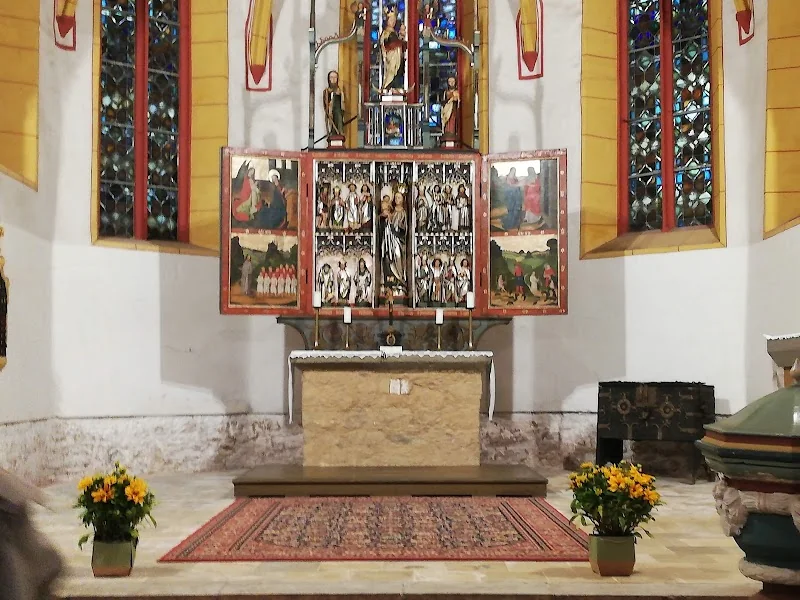
Langenberg also possesses impressive ecclesiastical historical depth in the parish area. The city of Gera describes the place as shaped by a long historical development and emphasizes that Langenberg is located in the northern city area and has a distinctive Protestant-Lutheran church. The oldest church in the area was the small castle chapel or Jacob's chapel; it was probably destroyed in 1430 by Hussite raids along with the castle and outbuilding, rebuilt in the 15th century, and later repurposed before being demolished in 1920 due to dilapidation. The current parish church has Romanesque elements in its oldest parts and existed as early as the 13th century. Its current appearance was shaped by renovations in 1754; the tower was built in 1502. Inside, there is the art-historically valuable Fourteen Holy Helpers altar, a carved altar from 1486 dedicated to the saints of the church. Right next to the church stands the parsonage, whose predecessor buildings have been documented since 1323, and whose current building dates from 1839. The hospital is also mentioned, as well as the early school tradition of the place, in which pastors and teachers were long closely connected. These details are more than mere chronology: they show how strongly church, education, care, and local development were intertwined in Langenberg. Today, those visiting the parish area encounter not just an office location but a historically grown ecclesiastical center. The connection to the present remains visible, as cultural and community formats take place on the parish square after renovations, and the place continues to be used as a space that fosters identity. Therefore, for those seeking the parish church, parsonage, a seat in the historical town center, or church history, Langenberg is a particularly relevant part of the overall location. Here it becomes clear how medieval origins, baroque renovations, and modern community practice complement each other in a village and urban landscape. ([gera.de](https://www.gera.de/verwaltung-buergerservice/ueber-gera/ortsteile-der-stadt-gera/ortsteil-langenberg))
Churches in the Parish Area: Gleina, Hartmannsdorf, and Pohlitz
The parish area thrives not only on the two main locations Langenberg and Bad Köstritz but also on the churches in the surrounding districts, which add additional historical depth to the whole. The official Bad Köstritz page describes the Gleina church as a Romanesque chapel, likely built between 1220 and 1250; after the Reformation, it was expanded and made significantly brighter by enlarged windows. This impressively shows how liturgical needs and architectural changes could adapt over centuries. For Hartmannsdorf, the city cites the first documentary mention from May 23, 1364, in a Reuss document. This firmly anchors the place historically and is part of that cultural landscape where church and settlement history are closely intertwined. Pohlitz is particularly old, where the church with cemetery was already established in the 12th century. The urban representation also makes it clear that Pohlitz lies east of Bad Köstritz on the White Elster and has an independent but closely connected location to the city. Additionally, Bad Köstritz itself has known a small church since at least 1320 according to the official city page, and the place name appears in documents as early as 1364. The castle ensemble with St. Leonhard Church, the connection to the House of Reuß, and the cultural influence of Heinrich Schütz, the dahlia garden, and the baroque city history give the parish area a profile that goes far beyond purely pastoral functions. For visitors coming from search terms like Gleina Church, Hartmannsdorf Church, or Pohlitz Church, it is important to understand: These places together form a religious network in which historical building substance, local identity, and today's community work are brought together. This diversity makes the parish area Gera-Langenberg - Bad Köstritz equally exciting for history enthusiasts, church members, and regional seekers. ([stadtbadkoestritz.de](https://www.stadtbadkoestritz.de/wirtschaft-tourismus/sehenswertes/))
Sources:
- EKM - Parish Area Langenberg - Bad Köstritz ([ekmd.de](https://www.ekmd.de/kirche/kirchenkreise/gera/langenberg-bad-koestritz))
- City Bad Köstritz - St. Leonhard Church ([stadtbadkoestritz.de](https://www.stadtbadkoestritz.de/wirtschaft-tourismus/sehenswertes/kirche-st-leonhard/))
- City Gera - District Langenberg ([gera.de](https://www.gera.de/verwaltung-buergerservice/ueber-gera/ortsteile-der-stadt-gera/ortsteil-langenberg))
- City Bad Köstritz - Sights ([stadtbadkoestritz.de](https://www.stadtbadkoestritz.de/wirtschaft-tourismus/sehenswertes/))
Show moreShow less
Evang. Parish Office Gera-Langenberg | Church & Worship
The Evang. Parish Office Gera-Langenberg - Bad Köstritz stands for a parish area that connects church history, regional cooperation, and vibrant community work. Those looking for contact, worship services, churches in the area, or the historical roots of Langenberg and Bad Köstritz will find here a place with a clear structure and surprisingly much substance. The regional community of the parish offices Bad Köstritz, Gera-Langenberg, and Pölzig is located at Zeitzer Str. 1 in Gera, while the parish area Langenberg-Bad Köstritz is additionally listed on the EKM site with Zeitzer Str. 3. This already makes it clear in the address that this area is not just a single office, but a church network of several locations, churches, and contacts. This connection of administrative proximity and historical depth makes the location interesting for church members, visitors, and anyone interested in Protestant churches in East Thuringia. ([ekmd.de](https://www.ekmd.de/kirche/kirchenkreise/gera/langenberg-bad-koestritz))
Regional Community of the Parish Offices and Local Contact
At the location Zeitzer Str. 1 in 07552 Gera, the regional community of the parish offices Bad Köstritz, Gera-Langenberg, and Pölzig can be reached. The official EKM site provides clear contact details: Phone 0365 20418403, Email regio.nord@gmx.de, as well as office hours on Monday from 10 to 12, Tuesday and Friday from 9 to 11, and Thursday from 15 to 17, and by appointment. Karin Rose is mentioned as the contact person for the regional community, Pastor Stephan Magirius at the location Zeitzer Str. 3 in Gera, and community educator Annett Beier. This means that the parish area is well organized and directly approachable for classic concerns such as appointment arrangements, pastoral conversations, information about worship services, or questions about the communities. The spatial separation between the regional community and the parish area is not a disadvantage but rather an expression of a developed church structure in which administration, pastoral care, and community work are distributed across several locations. For visitors and seekers, it is especially important: The address Zeitzer Str. 1 is the central orientation for the parish office, while the churches and community parts in Bad Köstritz, Langenberg, and the surrounding areas form the actual church presence in everyday life. Those planning an appointment should pay attention to the mentioned office hours and use the contact route of the regional community for substantive questions regarding community support, cemetery matters, or events. Thus, a simple parish office address becomes a reliable hub for the entire region. ([ekmd.de](https://www.ekmd.de/kirche/kirchenkreise/gera/langenberg-bad-koestritz))
Worship Services, Festive Services, and Church Life
Church life in the parish area Gera-Langenberg - Bad Köstritz is reflected not only in administrative structures but especially in the places where people come together: in the churches, in the parish squares, and at festive occasions throughout the year. This is particularly evident at the St. Leonhard Church in Bad Köstritz, which is described on the official city page as the center of Christian-religious life and a place of ecumenical encounters. Special festive services regularly take place there on special occasions, and the church also hosts organ and choir concerts as well as other musical events. This gives the location a role that goes far beyond the Sunday worship service. In Langenberg, the same idea is expressed in a different form: The city of Gera describes the parish square as a place where, after the renovation of Corylis Fountain, the oven in the parish courtyard, and the redesign, various events take place, including Easter market and light festival. Thus, the parish area connects liturgical tradition with public life and local culture. Those looking for a classic program in terms of concert, festive service, or community meeting will find here not an anonymous large structure but a manageable church landscape with personal closeness. The EKM structure itself also indicates that events and worship services are maintained as separate information areas. This is important for seekers because it allows dates, locations, and contacts to be quickly categorized. Especially in the rural Thuringia, it is often not large halls but churches, parish courtyards, and small squares that visibly structure the year. In the parish area Langenberg-Bad Köstritz, this is exactly the case: worship, music, devotion, encounters, and volunteer work interlock and make the church presence in everyday life tangible. ([ekmd.de](https://www.ekmd.de/kirche/kirchenkreise/gera/langenberg-bad-koestritz))
Directions to Gera-Langenberg and Bad Köstritz
For practical orientation, the district of Langenberg in Gera is especially important because the church focus of the parish area is concentrated there. The city of Gera describes Langenberg as a district in the northern city area, bordered by the B7, B2, the White Elster, and the railway line Gera/Leipzig. Internal access is via local roads, and there is also a stop on the Gera/Leipzig railway line. Those arriving by public transport can reach Langenberg via bus lines 203, 204, 228, and 229 of the Regionalverkehr Gera/Land GmbH from the transfer point Duale Hochschule; there is also a direct connection to the A4. This location explains why the parish area is easily accessible for people from Gera, the Elstertal, and the surrounding areas. Bad Köstritz is also conveniently located in terms of transport, as the city points to its location in the Elstertal and several interregional connections in the vicinity. For visitors, this means: The way to the parish office or to a church is usually more a matter of proper orientation than complicated logistics. Particularly helpful is that the St. Leonhard Church in Bad Köstritz is clearly present in the cityscape, and the parish church in Langenberg is described as a prominent district point. Therefore, those planning the journey should first choose the respective church location and then the nearest connection to the train, bus, or federal road. Specific, officially designated parking information is not prominently published for the parish office; therefore, for reliable planning, the public transport routes, the railway line, and the city description are the safest points of reference. This way, the visit can be well combined with a walk through the historical village structure, with a devotion or an appointment at the parish office. ([gera.de](https://www.gera.de/verwaltung-buergerservice/ueber-gera/ortsteile-der-stadt-gera/ortsteil-langenberg))
St. Leonhard Church in Bad Köstritz
The St. Leonhard Church is one of the most important anchor points of the parish area and at the same time a remarkable architectural and cultural monument. The official city page of Bad Köstritz cites the year 1320 in the cathedral archive in Naumburg as the first documentary mention and points out that the building stock is older. In the Middle Ages, the church belonged to the Diocese of Naumburg and was later dedicated to Saint Leonhard. The building history is multifaceted: the church was newly built in 1507, redesigned in the early 19th century. The tower received its atypical shape for the region, presumably according to plans by Karl Friedrich Schinkel, who stayed in Köstritz around 1800. In 1891, the interior was redesigned in the neo-Romanesque style with altar, pulpit, and stained glass windows by Köstritz builders and carpenters. Between 1998 and 2001, a comprehensive exterior renovation followed, during which the tower, roof, nave, bell tower, and colored stained glass windows were restored. The church has a particularly strong ecclesiastical and cultural historical connection to the city through Heinrich Schütz, who was baptized in this church in 1585. The city also emphasizes that other personalities such as Magister Johann Junghanns, David Friedrich Schott, Julius Sturm, and Werner Sylten are connected to the church. For today's visitors, St. Leonhard is not only a historical building but a vibrant place: festive worship services, organ and choir concerts, and ecumenical encounters shape the profile. The location at the castle and park ensemble further enhances the impression, as the church is part of an urban and culturally closely intertwined area. Those interested in Protestant churches in Thuringia will find here an example of how medieval origins, baroque and neo-Romanesque designs, and today's community life overlap at a single location. ([stadtbadkoestritz.de](https://www.stadtbadkoestritz.de/wirtschaft-tourismus/sehenswertes/kirche-st-leonhard/))
Parish Church, Parsonage, and Historical Depth in Langenberg
Langenberg also possesses impressive ecclesiastical historical depth in the parish area. The city of Gera describes the place as shaped by a long historical development and emphasizes that Langenberg is located in the northern city area and has a distinctive Protestant-Lutheran church. The oldest church in the area was the small castle chapel or Jacob's chapel; it was probably destroyed in 1430 by Hussite raids along with the castle and outbuilding, rebuilt in the 15th century, and later repurposed before being demolished in 1920 due to dilapidation. The current parish church has Romanesque elements in its oldest parts and existed as early as the 13th century. Its current appearance was shaped by renovations in 1754; the tower was built in 1502. Inside, there is the art-historically valuable Fourteen Holy Helpers altar, a carved altar from 1486 dedicated to the saints of the church. Right next to the church stands the parsonage, whose predecessor buildings have been documented since 1323, and whose current building dates from 1839. The hospital is also mentioned, as well as the early school tradition of the place, in which pastors and teachers were long closely connected. These details are more than mere chronology: they show how strongly church, education, care, and local development were intertwined in Langenberg. Today, those visiting the parish area encounter not just an office location but a historically grown ecclesiastical center. The connection to the present remains visible, as cultural and community formats take place on the parish square after renovations, and the place continues to be used as a space that fosters identity. Therefore, for those seeking the parish church, parsonage, a seat in the historical town center, or church history, Langenberg is a particularly relevant part of the overall location. Here it becomes clear how medieval origins, baroque renovations, and modern community practice complement each other in a village and urban landscape. ([gera.de](https://www.gera.de/verwaltung-buergerservice/ueber-gera/ortsteile-der-stadt-gera/ortsteil-langenberg))
Churches in the Parish Area: Gleina, Hartmannsdorf, and Pohlitz
The parish area thrives not only on the two main locations Langenberg and Bad Köstritz but also on the churches in the surrounding districts, which add additional historical depth to the whole. The official Bad Köstritz page describes the Gleina church as a Romanesque chapel, likely built between 1220 and 1250; after the Reformation, it was expanded and made significantly brighter by enlarged windows. This impressively shows how liturgical needs and architectural changes could adapt over centuries. For Hartmannsdorf, the city cites the first documentary mention from May 23, 1364, in a Reuss document. This firmly anchors the place historically and is part of that cultural landscape where church and settlement history are closely intertwined. Pohlitz is particularly old, where the church with cemetery was already established in the 12th century. The urban representation also makes it clear that Pohlitz lies east of Bad Köstritz on the White Elster and has an independent but closely connected location to the city. Additionally, Bad Köstritz itself has known a small church since at least 1320 according to the official city page, and the place name appears in documents as early as 1364. The castle ensemble with St. Leonhard Church, the connection to the House of Reuß, and the cultural influence of Heinrich Schütz, the dahlia garden, and the baroque city history give the parish area a profile that goes far beyond purely pastoral functions. For visitors coming from search terms like Gleina Church, Hartmannsdorf Church, or Pohlitz Church, it is important to understand: These places together form a religious network in which historical building substance, local identity, and today's community work are brought together. This diversity makes the parish area Gera-Langenberg - Bad Köstritz equally exciting for history enthusiasts, church members, and regional seekers. ([stadtbadkoestritz.de](https://www.stadtbadkoestritz.de/wirtschaft-tourismus/sehenswertes/))
Sources:
- EKM - Parish Area Langenberg - Bad Köstritz ([ekmd.de](https://www.ekmd.de/kirche/kirchenkreise/gera/langenberg-bad-koestritz))
- City Bad Köstritz - St. Leonhard Church ([stadtbadkoestritz.de](https://www.stadtbadkoestritz.de/wirtschaft-tourismus/sehenswertes/kirche-st-leonhard/))
- City Gera - District Langenberg ([gera.de](https://www.gera.de/verwaltung-buergerservice/ueber-gera/ortsteile-der-stadt-gera/ortsteil-langenberg))
- City Bad Köstritz - Sights ([stadtbadkoestritz.de](https://www.stadtbadkoestritz.de/wirtschaft-tourismus/sehenswertes/))
Evang. Parish Office Gera-Langenberg | Church & Worship
The Evang. Parish Office Gera-Langenberg - Bad Köstritz stands for a parish area that connects church history, regional cooperation, and vibrant community work. Those looking for contact, worship services, churches in the area, or the historical roots of Langenberg and Bad Köstritz will find here a place with a clear structure and surprisingly much substance. The regional community of the parish offices Bad Köstritz, Gera-Langenberg, and Pölzig is located at Zeitzer Str. 1 in Gera, while the parish area Langenberg-Bad Köstritz is additionally listed on the EKM site with Zeitzer Str. 3. This already makes it clear in the address that this area is not just a single office, but a church network of several locations, churches, and contacts. This connection of administrative proximity and historical depth makes the location interesting for church members, visitors, and anyone interested in Protestant churches in East Thuringia. ([ekmd.de](https://www.ekmd.de/kirche/kirchenkreise/gera/langenberg-bad-koestritz))
Regional Community of the Parish Offices and Local Contact
At the location Zeitzer Str. 1 in 07552 Gera, the regional community of the parish offices Bad Köstritz, Gera-Langenberg, and Pölzig can be reached. The official EKM site provides clear contact details: Phone 0365 20418403, Email regio.nord@gmx.de, as well as office hours on Monday from 10 to 12, Tuesday and Friday from 9 to 11, and Thursday from 15 to 17, and by appointment. Karin Rose is mentioned as the contact person for the regional community, Pastor Stephan Magirius at the location Zeitzer Str. 3 in Gera, and community educator Annett Beier. This means that the parish area is well organized and directly approachable for classic concerns such as appointment arrangements, pastoral conversations, information about worship services, or questions about the communities. The spatial separation between the regional community and the parish area is not a disadvantage but rather an expression of a developed church structure in which administration, pastoral care, and community work are distributed across several locations. For visitors and seekers, it is especially important: The address Zeitzer Str. 1 is the central orientation for the parish office, while the churches and community parts in Bad Köstritz, Langenberg, and the surrounding areas form the actual church presence in everyday life. Those planning an appointment should pay attention to the mentioned office hours and use the contact route of the regional community for substantive questions regarding community support, cemetery matters, or events. Thus, a simple parish office address becomes a reliable hub for the entire region. ([ekmd.de](https://www.ekmd.de/kirche/kirchenkreise/gera/langenberg-bad-koestritz))
Worship Services, Festive Services, and Church Life
Church life in the parish area Gera-Langenberg - Bad Köstritz is reflected not only in administrative structures but especially in the places where people come together: in the churches, in the parish squares, and at festive occasions throughout the year. This is particularly evident at the St. Leonhard Church in Bad Köstritz, which is described on the official city page as the center of Christian-religious life and a place of ecumenical encounters. Special festive services regularly take place there on special occasions, and the church also hosts organ and choir concerts as well as other musical events. This gives the location a role that goes far beyond the Sunday worship service. In Langenberg, the same idea is expressed in a different form: The city of Gera describes the parish square as a place where, after the renovation of Corylis Fountain, the oven in the parish courtyard, and the redesign, various events take place, including Easter market and light festival. Thus, the parish area connects liturgical tradition with public life and local culture. Those looking for a classic program in terms of concert, festive service, or community meeting will find here not an anonymous large structure but a manageable church landscape with personal closeness. The EKM structure itself also indicates that events and worship services are maintained as separate information areas. This is important for seekers because it allows dates, locations, and contacts to be quickly categorized. Especially in the rural Thuringia, it is often not large halls but churches, parish courtyards, and small squares that visibly structure the year. In the parish area Langenberg-Bad Köstritz, this is exactly the case: worship, music, devotion, encounters, and volunteer work interlock and make the church presence in everyday life tangible. ([ekmd.de](https://www.ekmd.de/kirche/kirchenkreise/gera/langenberg-bad-koestritz))
Directions to Gera-Langenberg and Bad Köstritz
For practical orientation, the district of Langenberg in Gera is especially important because the church focus of the parish area is concentrated there. The city of Gera describes Langenberg as a district in the northern city area, bordered by the B7, B2, the White Elster, and the railway line Gera/Leipzig. Internal access is via local roads, and there is also a stop on the Gera/Leipzig railway line. Those arriving by public transport can reach Langenberg via bus lines 203, 204, 228, and 229 of the Regionalverkehr Gera/Land GmbH from the transfer point Duale Hochschule; there is also a direct connection to the A4. This location explains why the parish area is easily accessible for people from Gera, the Elstertal, and the surrounding areas. Bad Köstritz is also conveniently located in terms of transport, as the city points to its location in the Elstertal and several interregional connections in the vicinity. For visitors, this means: The way to the parish office or to a church is usually more a matter of proper orientation than complicated logistics. Particularly helpful is that the St. Leonhard Church in Bad Köstritz is clearly present in the cityscape, and the parish church in Langenberg is described as a prominent district point. Therefore, those planning the journey should first choose the respective church location and then the nearest connection to the train, bus, or federal road. Specific, officially designated parking information is not prominently published for the parish office; therefore, for reliable planning, the public transport routes, the railway line, and the city description are the safest points of reference. This way, the visit can be well combined with a walk through the historical village structure, with a devotion or an appointment at the parish office. ([gera.de](https://www.gera.de/verwaltung-buergerservice/ueber-gera/ortsteile-der-stadt-gera/ortsteil-langenberg))
St. Leonhard Church in Bad Köstritz
The St. Leonhard Church is one of the most important anchor points of the parish area and at the same time a remarkable architectural and cultural monument. The official city page of Bad Köstritz cites the year 1320 in the cathedral archive in Naumburg as the first documentary mention and points out that the building stock is older. In the Middle Ages, the church belonged to the Diocese of Naumburg and was later dedicated to Saint Leonhard. The building history is multifaceted: the church was newly built in 1507, redesigned in the early 19th century. The tower received its atypical shape for the region, presumably according to plans by Karl Friedrich Schinkel, who stayed in Köstritz around 1800. In 1891, the interior was redesigned in the neo-Romanesque style with altar, pulpit, and stained glass windows by Köstritz builders and carpenters. Between 1998 and 2001, a comprehensive exterior renovation followed, during which the tower, roof, nave, bell tower, and colored stained glass windows were restored. The church has a particularly strong ecclesiastical and cultural historical connection to the city through Heinrich Schütz, who was baptized in this church in 1585. The city also emphasizes that other personalities such as Magister Johann Junghanns, David Friedrich Schott, Julius Sturm, and Werner Sylten are connected to the church. For today's visitors, St. Leonhard is not only a historical building but a vibrant place: festive worship services, organ and choir concerts, and ecumenical encounters shape the profile. The location at the castle and park ensemble further enhances the impression, as the church is part of an urban and culturally closely intertwined area. Those interested in Protestant churches in Thuringia will find here an example of how medieval origins, baroque and neo-Romanesque designs, and today's community life overlap at a single location. ([stadtbadkoestritz.de](https://www.stadtbadkoestritz.de/wirtschaft-tourismus/sehenswertes/kirche-st-leonhard/))
Parish Church, Parsonage, and Historical Depth in Langenberg
Langenberg also possesses impressive ecclesiastical historical depth in the parish area. The city of Gera describes the place as shaped by a long historical development and emphasizes that Langenberg is located in the northern city area and has a distinctive Protestant-Lutheran church. The oldest church in the area was the small castle chapel or Jacob's chapel; it was probably destroyed in 1430 by Hussite raids along with the castle and outbuilding, rebuilt in the 15th century, and later repurposed before being demolished in 1920 due to dilapidation. The current parish church has Romanesque elements in its oldest parts and existed as early as the 13th century. Its current appearance was shaped by renovations in 1754; the tower was built in 1502. Inside, there is the art-historically valuable Fourteen Holy Helpers altar, a carved altar from 1486 dedicated to the saints of the church. Right next to the church stands the parsonage, whose predecessor buildings have been documented since 1323, and whose current building dates from 1839. The hospital is also mentioned, as well as the early school tradition of the place, in which pastors and teachers were long closely connected. These details are more than mere chronology: they show how strongly church, education, care, and local development were intertwined in Langenberg. Today, those visiting the parish area encounter not just an office location but a historically grown ecclesiastical center. The connection to the present remains visible, as cultural and community formats take place on the parish square after renovations, and the place continues to be used as a space that fosters identity. Therefore, for those seeking the parish church, parsonage, a seat in the historical town center, or church history, Langenberg is a particularly relevant part of the overall location. Here it becomes clear how medieval origins, baroque renovations, and modern community practice complement each other in a village and urban landscape. ([gera.de](https://www.gera.de/verwaltung-buergerservice/ueber-gera/ortsteile-der-stadt-gera/ortsteil-langenberg))
Churches in the Parish Area: Gleina, Hartmannsdorf, and Pohlitz
The parish area thrives not only on the two main locations Langenberg and Bad Köstritz but also on the churches in the surrounding districts, which add additional historical depth to the whole. The official Bad Köstritz page describes the Gleina church as a Romanesque chapel, likely built between 1220 and 1250; after the Reformation, it was expanded and made significantly brighter by enlarged windows. This impressively shows how liturgical needs and architectural changes could adapt over centuries. For Hartmannsdorf, the city cites the first documentary mention from May 23, 1364, in a Reuss document. This firmly anchors the place historically and is part of that cultural landscape where church and settlement history are closely intertwined. Pohlitz is particularly old, where the church with cemetery was already established in the 12th century. The urban representation also makes it clear that Pohlitz lies east of Bad Köstritz on the White Elster and has an independent but closely connected location to the city. Additionally, Bad Köstritz itself has known a small church since at least 1320 according to the official city page, and the place name appears in documents as early as 1364. The castle ensemble with St. Leonhard Church, the connection to the House of Reuß, and the cultural influence of Heinrich Schütz, the dahlia garden, and the baroque city history give the parish area a profile that goes far beyond purely pastoral functions. For visitors coming from search terms like Gleina Church, Hartmannsdorf Church, or Pohlitz Church, it is important to understand: These places together form a religious network in which historical building substance, local identity, and today's community work are brought together. This diversity makes the parish area Gera-Langenberg - Bad Köstritz equally exciting for history enthusiasts, church members, and regional seekers. ([stadtbadkoestritz.de](https://www.stadtbadkoestritz.de/wirtschaft-tourismus/sehenswertes/))
Sources:
- EKM - Parish Area Langenberg - Bad Köstritz ([ekmd.de](https://www.ekmd.de/kirche/kirchenkreise/gera/langenberg-bad-koestritz))
- City Bad Köstritz - St. Leonhard Church ([stadtbadkoestritz.de](https://www.stadtbadkoestritz.de/wirtschaft-tourismus/sehenswertes/kirche-st-leonhard/))
- City Gera - District Langenberg ([gera.de](https://www.gera.de/verwaltung-buergerservice/ueber-gera/ortsteile-der-stadt-gera/ortsteil-langenberg))
- City Bad Köstritz - Sights ([stadtbadkoestritz.de](https://www.stadtbadkoestritz.de/wirtschaft-tourismus/sehenswertes/))
Upcoming Events
No events found
Frequently Asked Questions
Reviews
Anja Musiol
7. August 2018
Very nice community. Open and fun pastor. Offers for children are very loving and educationally valuable. There are also nice offerings for older people to be in community.
Margit Bachmann
25. December 2021
I have been receiving help, advice, and simply the feeling of being welcome in this community for several years. This is probably the most important thing in life!!! Togetherness and respect for one another are the key ingredients for a bearable life! This is promoted in this community!
Andrea Annelena Dressel
8. November 2021
Beautiful church! The restored altar is back! Worth seeing ⛪
Stefan Kasubek
26. May 2019
Very inspiring place. Good for finding inner peace.
Timo Otto
15. August 2021
The coolest, most open-minded Protestant pastor there is.