
Gera
07545 Gera, Deutschland
Gera, Sorge / Markt | Access & Parking
Gera, Sorge / Markt is less a single object than a compact piece of downtown, where the historic marketplace, shopping street, and short distances overlap. Those who arrive here find themselves in the midst of Gera's urban core: The town hall, the city pharmacy, and the Simson fountain characterize the market, while Sorge is perceived as the shopping street and main axis of the city center. The city explicitly describes the promenade between Heinrichstraße and Schloßstraße, Sorge and Markt as a place for strolling, shopping, dining, and going out. For visitors, the location is particularly practical because it connects many things in a small space: sights, gastronomy, stops, parking garages, and the paths to the rest of the city center. This mix makes the location highly relevant for local search queries, as everyday paths, city center visits, and city history come together directly here. At the same time, the address is not an isolated point but part of a larger city center development that aims to visibly enhance Sorge and strengthen the marketplace as the central meeting point of the city. ([gera.de](https://www.gera.de/verwaltung-buergerservice/ueber-gera/entdecken-sie-gera))
Market Square Gera with Town Hall, City Pharmacy, and Simson Fountain
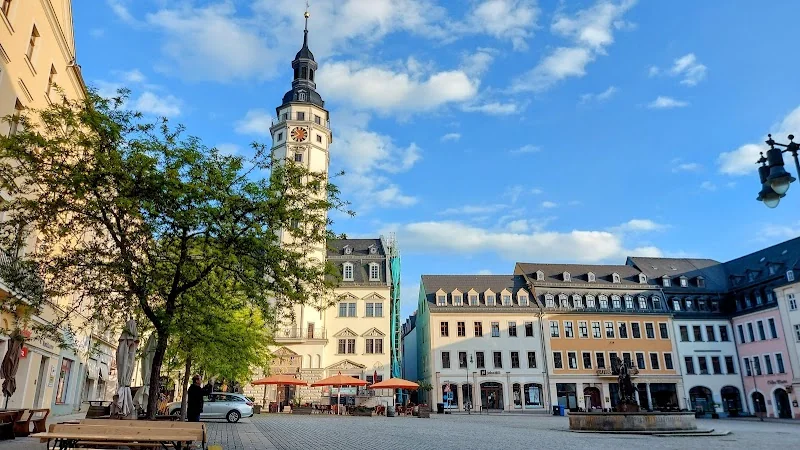
The Gera Market Square is one of the most prominent places in the city because it acts as a closed ensemble and is completely surrounded by buildings. According to the city's information, it is accessible via six entrances and measures 4,365 square meters with a circumference of 280 meters; there are 144,000 paving stones on the area. This hard urban space quality is important because it shows the square not only as a beautiful photo motif but as a functioning public space. Additionally, there is the historical structure of the town hall, city pharmacy, and Simson fountain. The city pharmacy, with its Renaissance style and the corner from 1606, forms an ensemble with the fountain and the citizens' houses that spatially and architecturally holds the square together. Therefore, when entering the market, one does not experience a random edge of the square but a carefully readable historical center that is closely linked to the urban self-understanding. ([gera.de](https://www.gera.de/tourismus-freizeit-kultur/stadt-erleben/sehenswertes/markt))
Particularly striking is the Renaissance town hall, built from 1573 to 1576, which dominates the square with its 57-meter-high tower. Since 1988, a hand-played carillon with 37 bells has been ringing in the tower lantern, giving the place an acoustic identity that is immediately noticeable during a short visit. The Simson fountain is also one of the defining elements of the market; the city mentions it as part of the closed ensemble and refers to its creation in 1685/86 by Christof Junghans. Additionally, the city emphasizes that the marketplace offers gastronomic options, selected shops, and direct paths to other city center points, including the city museum and the culture and congress center. Thus, the market is not only a monument space but also a starting point for a city center stroll with history, architecture, and amenities all in one place. ([gera.de](https://www.gera.de/tourismus-freizeit-kultur/stadt-erleben/sehenswertes/markt))
Getting to Sorge / Markt by Tram, Bus, and Train
The location for getting to Sorge / Markt is surprisingly versatile. By car, the city names the A4 as well as the B2, B7, and B92 as regional axes; the highway access is via the exits Gera-Langenberg, Gera, and Gera-Leumnitz. This is important for visitors coming from Leipzig, Jena, Erfurt, Greiz, or Plauen who are looking for a central city center address. The train junction is also manageable: The city names Gera main station and Gera South as train stations. Those arriving by train can reach the city center from there via the inner-city transport. This structure is particularly attractive for short city visits because it separates the journey and inner-city paths: first the journey to Gera, then the compact, walkable city center area around Markt and Sorge. ([gera.de](https://www.gera.de/tourismus-freizeit-kultur/gera-information/anreise))
In public transport, the logic of stops for this location is particularly clear. The city explicitly names the stop Sorge / Markt as well as the stops Heinrichstraße - a central transfer point - and Stadtgraben. In the schedule data for line 3, Sorge / Markt appears as its own stop, making the location very easy to find for tram users. For city visits, this means: Those who are in the city center do not have to plan complicated detours but can work with a few orienting terms - Markt, Sorge, Heinrichstraße, or Stadtgraben. This is exactly why the location works so well for local search queries. It is not just an address but a hub of footpaths, stops, and short transitions between central city areas. ([gera.de](https://www.gera.de/tourismus-freizeit-kultur/gera-information/anreise))
Parking at the Market, Town Hall, and in the City Center of Gera
When it comes to parking, Gera, Sorge / Markt is particularly focused on comfort. The parking garage Markt / Rathaus on Nicolaistraße is located directly at the center and advertises its location at the market and town hall. According to the operator, 322 parking spaces are available; the entrance height is 2.00 meters, and it is open daily from 06:00 to 23:00, while the exit is possible at any time. The parking system operates without tickets using license plate recognition, and payment can be made in cash, by EC card, credit card, Apple Pay, or Google Pay. For short visits, the daily price is particularly relevant: 2.50 euros for the calendar day from 00:00 to 24:00. Thus, the parking garage is not only functional but also easy to calculate - an advantage for city center visits, official errands, shopping rounds, or a spontaneous market visit. ([parkausammarktgera.de](https://www.parkausammarktgera.de/))
The city's parking overview additionally confirms parking in the immediate vicinity of the city center with the parking garage Markt / Rathaus and the parking lot at the market in Stadtgraben. The area around the Salvatorkirche is also mentioned as a paid parking option for those who prefer to walk towards the historic center. For visitors, this combination is crucial because it meets various needs: parking close to the garage for longer stays and open parking options for shorter distances. In a city center area that is simultaneously a shopping street, market, and event space, such details determine whether a visit is relaxed or stressful. The available parking offers make the Sorge / Markt location not only accessible but also practical for everyday use. ([gera.de](https://www.gera.de/leben-in-gera/mobilitaet-verkehr-rad/parkplaetze))
Sorge as a Shopping Street, Promenade, and Everyday Address
Sorge is much more than a street to drive through in Gera. The city describes it as a shopping street and as part of the city center promenade between Heinrichstraße and Schloßstraße, Sorge and Markt. At the same time, the official city description points out that Gera offers around 1,110 shops and 230,000 square meters of retail space throughout the city, and the city center has changed significantly since 1989. This makes the Sorge / Markt location a typical search area for local everyday questions: People come here not only for sights but also for appointments, shopping, gastronomy, and paths to the rest of the city center. This is important for SEO because search intent and urban space coincide closely: Those searching for Sorge often do not want an abstract city description but a lively, concrete city center location with orientation, shops, and short paths. ([gera.de](https://www.gera.de/verwaltung-buergerservice/ueber-gera/entdecken-sie-gera))
The city is also trying to visibly enhance Sorge. In the action Zukunft Sorge - A Street Full of Wishes, the shopping street was covered with around 125 colorful umbrellas to strengthen the perception of the area and attract curiosity to the street. This measure shows that Sorge plays an important role not only functionally but also aesthetically. Together with the market, it creates a downtown band that consists not only of facades but is actively understood as a space for staying and meeting. Therefore, those who stroll here experience a mix of classic city center, small staging, and everyday urban use. This mix makes the place interesting for families, visitors, locals, and occasional customers alike. ([gera.de](https://www.gera.de/meldung/medieninformation-die-sorge-wird-bunt-zukunft-sorge-eine-strasse-voller-wuensche))
Events, Markets, and City Festivals around Markt and Sorge
A dense market activity takes place around Markt and Sorge throughout the year. The city mentions the weekly market as well as special markets such as gardener market days, farmers' market, pottery market, French market, and the fairy tale market. The usual market days for the weekly market are Tuesday, Thursday, and Friday; during the fairy tale market, it is temporarily relocated to Zschochernplatz. This shows that the marketplace is not only a historical place but a real production space of urban everyday life. The area thus lives in the rhythm of trade, seasonality, and festive operations. For visitors, this is attractive because the square does not just remain a backdrop but is regularly filled with goods, stalls, and additional offers. ([gera.de](https://www.gera.de/tourismus-freizeit-kultur/veranstaltungen/maerkte-sondermaerkte?utm_source=openai))
The city's major festivals also explicitly include the area. The fairy tale market begins at the city museum and stretches through Bachgasse and Johannisgasse to the marketplace; numerous programs for young and old take place on the stage at the market. At the Höhlerfest, the festival mile extends from Puschkin and museum square through Markt, Sorge, and Große Kirchstraße to Zschochernplatz. This is crucial for the location description: Markt and Sorge are not peripheral areas but central axes in the event scene. Therefore, those planning a visit should not only think about access and parking but also about dates, as stages, parades, or market stalls can quickly shape the image at Markt and Sorge. This gives the address a special mix of everyday place and festive location. ([gera.de](https://www.gera.de/tourismus-freizeit-kultur/maerkte-und-feste/maerkte-sondermaerkte/weihnachtsmarkt-/-maerchenmarkt))
Orientation, Path Guidance, and Practical Tips for the Visit
For practical orientation, several city center destinations are reachable within a few steps around Sorge / Markt. The city emphasizes that the new campus of the Goethe Gymnasium, the city museum, and the culture and congress center are quickly accessible from there. Together with the town hall, the market, and the shopping location, this creates a very compact urban space that is particularly easy to explore on foot. This is an advantage for people who are looking for a specific address and do not want to struggle with an entire district. In short: Those who need a central starting point for appointments, strolls, market visits, or a detour to the historic center in Gera will find a functioning urban center with clear paths and many connection points here. ([gera.de](https://www.gera.de/tourismus-freizeit-kultur/stadt-erleben/sehenswertes/markt))
From the official information, it can also be inferred that the location is particularly sensible for combined errands: arriving, parking, walking short distances, and completing several goals in succession. The market has several entrances, the parking garage is directly at the center, and the stop Sorge / Markt makes public transport easy. For local search queries like Gera, Sorge / Markt, Gera Sorge, or Gera Markt, this is ideal because the area offers exactly the mix that city visitors often seek: historical backdrop, functioning infrastructure, and a lively environment with shops, gastronomy, and events. Therefore, anyone placing an address in the heart of Gera should always think of Sorge and Markt together - as a cohesive city center location that bundles history and present in one place. ([gera.de](https://www.gera.de/tourismus-freizeit-kultur/stadt-erleben/sehenswertes/markt))
Sources:
Show moreShow less
Gera, Sorge / Markt | Access & Parking
Gera, Sorge / Markt is less a single object than a compact piece of downtown, where the historic marketplace, shopping street, and short distances overlap. Those who arrive here find themselves in the midst of Gera's urban core: The town hall, the city pharmacy, and the Simson fountain characterize the market, while Sorge is perceived as the shopping street and main axis of the city center. The city explicitly describes the promenade between Heinrichstraße and Schloßstraße, Sorge and Markt as a place for strolling, shopping, dining, and going out. For visitors, the location is particularly practical because it connects many things in a small space: sights, gastronomy, stops, parking garages, and the paths to the rest of the city center. This mix makes the location highly relevant for local search queries, as everyday paths, city center visits, and city history come together directly here. At the same time, the address is not an isolated point but part of a larger city center development that aims to visibly enhance Sorge and strengthen the marketplace as the central meeting point of the city. ([gera.de](https://www.gera.de/verwaltung-buergerservice/ueber-gera/entdecken-sie-gera))
Market Square Gera with Town Hall, City Pharmacy, and Simson Fountain
The Gera Market Square is one of the most prominent places in the city because it acts as a closed ensemble and is completely surrounded by buildings. According to the city's information, it is accessible via six entrances and measures 4,365 square meters with a circumference of 280 meters; there are 144,000 paving stones on the area. This hard urban space quality is important because it shows the square not only as a beautiful photo motif but as a functioning public space. Additionally, there is the historical structure of the town hall, city pharmacy, and Simson fountain. The city pharmacy, with its Renaissance style and the corner from 1606, forms an ensemble with the fountain and the citizens' houses that spatially and architecturally holds the square together. Therefore, when entering the market, one does not experience a random edge of the square but a carefully readable historical center that is closely linked to the urban self-understanding. ([gera.de](https://www.gera.de/tourismus-freizeit-kultur/stadt-erleben/sehenswertes/markt))
Particularly striking is the Renaissance town hall, built from 1573 to 1576, which dominates the square with its 57-meter-high tower. Since 1988, a hand-played carillon with 37 bells has been ringing in the tower lantern, giving the place an acoustic identity that is immediately noticeable during a short visit. The Simson fountain is also one of the defining elements of the market; the city mentions it as part of the closed ensemble and refers to its creation in 1685/86 by Christof Junghans. Additionally, the city emphasizes that the marketplace offers gastronomic options, selected shops, and direct paths to other city center points, including the city museum and the culture and congress center. Thus, the market is not only a monument space but also a starting point for a city center stroll with history, architecture, and amenities all in one place. ([gera.de](https://www.gera.de/tourismus-freizeit-kultur/stadt-erleben/sehenswertes/markt))
Getting to Sorge / Markt by Tram, Bus, and Train
The location for getting to Sorge / Markt is surprisingly versatile. By car, the city names the A4 as well as the B2, B7, and B92 as regional axes; the highway access is via the exits Gera-Langenberg, Gera, and Gera-Leumnitz. This is important for visitors coming from Leipzig, Jena, Erfurt, Greiz, or Plauen who are looking for a central city center address. The train junction is also manageable: The city names Gera main station and Gera South as train stations. Those arriving by train can reach the city center from there via the inner-city transport. This structure is particularly attractive for short city visits because it separates the journey and inner-city paths: first the journey to Gera, then the compact, walkable city center area around Markt and Sorge. ([gera.de](https://www.gera.de/tourismus-freizeit-kultur/gera-information/anreise))
In public transport, the logic of stops for this location is particularly clear. The city explicitly names the stop Sorge / Markt as well as the stops Heinrichstraße - a central transfer point - and Stadtgraben. In the schedule data for line 3, Sorge / Markt appears as its own stop, making the location very easy to find for tram users. For city visits, this means: Those who are in the city center do not have to plan complicated detours but can work with a few orienting terms - Markt, Sorge, Heinrichstraße, or Stadtgraben. This is exactly why the location works so well for local search queries. It is not just an address but a hub of footpaths, stops, and short transitions between central city areas. ([gera.de](https://www.gera.de/tourismus-freizeit-kultur/gera-information/anreise))
Parking at the Market, Town Hall, and in the City Center of Gera
When it comes to parking, Gera, Sorge / Markt is particularly focused on comfort. The parking garage Markt / Rathaus on Nicolaistraße is located directly at the center and advertises its location at the market and town hall. According to the operator, 322 parking spaces are available; the entrance height is 2.00 meters, and it is open daily from 06:00 to 23:00, while the exit is possible at any time. The parking system operates without tickets using license plate recognition, and payment can be made in cash, by EC card, credit card, Apple Pay, or Google Pay. For short visits, the daily price is particularly relevant: 2.50 euros for the calendar day from 00:00 to 24:00. Thus, the parking garage is not only functional but also easy to calculate - an advantage for city center visits, official errands, shopping rounds, or a spontaneous market visit. ([parkausammarktgera.de](https://www.parkausammarktgera.de/))
The city's parking overview additionally confirms parking in the immediate vicinity of the city center with the parking garage Markt / Rathaus and the parking lot at the market in Stadtgraben. The area around the Salvatorkirche is also mentioned as a paid parking option for those who prefer to walk towards the historic center. For visitors, this combination is crucial because it meets various needs: parking close to the garage for longer stays and open parking options for shorter distances. In a city center area that is simultaneously a shopping street, market, and event space, such details determine whether a visit is relaxed or stressful. The available parking offers make the Sorge / Markt location not only accessible but also practical for everyday use. ([gera.de](https://www.gera.de/leben-in-gera/mobilitaet-verkehr-rad/parkplaetze))
Sorge as a Shopping Street, Promenade, and Everyday Address
Sorge is much more than a street to drive through in Gera. The city describes it as a shopping street and as part of the city center promenade between Heinrichstraße and Schloßstraße, Sorge and Markt. At the same time, the official city description points out that Gera offers around 1,110 shops and 230,000 square meters of retail space throughout the city, and the city center has changed significantly since 1989. This makes the Sorge / Markt location a typical search area for local everyday questions: People come here not only for sights but also for appointments, shopping, gastronomy, and paths to the rest of the city center. This is important for SEO because search intent and urban space coincide closely: Those searching for Sorge often do not want an abstract city description but a lively, concrete city center location with orientation, shops, and short paths. ([gera.de](https://www.gera.de/verwaltung-buergerservice/ueber-gera/entdecken-sie-gera))
The city is also trying to visibly enhance Sorge. In the action Zukunft Sorge - A Street Full of Wishes, the shopping street was covered with around 125 colorful umbrellas to strengthen the perception of the area and attract curiosity to the street. This measure shows that Sorge plays an important role not only functionally but also aesthetically. Together with the market, it creates a downtown band that consists not only of facades but is actively understood as a space for staying and meeting. Therefore, those who stroll here experience a mix of classic city center, small staging, and everyday urban use. This mix makes the place interesting for families, visitors, locals, and occasional customers alike. ([gera.de](https://www.gera.de/meldung/medieninformation-die-sorge-wird-bunt-zukunft-sorge-eine-strasse-voller-wuensche))
Events, Markets, and City Festivals around Markt and Sorge
A dense market activity takes place around Markt and Sorge throughout the year. The city mentions the weekly market as well as special markets such as gardener market days, farmers' market, pottery market, French market, and the fairy tale market. The usual market days for the weekly market are Tuesday, Thursday, and Friday; during the fairy tale market, it is temporarily relocated to Zschochernplatz. This shows that the marketplace is not only a historical place but a real production space of urban everyday life. The area thus lives in the rhythm of trade, seasonality, and festive operations. For visitors, this is attractive because the square does not just remain a backdrop but is regularly filled with goods, stalls, and additional offers. ([gera.de](https://www.gera.de/tourismus-freizeit-kultur/veranstaltungen/maerkte-sondermaerkte?utm_source=openai))
The city's major festivals also explicitly include the area. The fairy tale market begins at the city museum and stretches through Bachgasse and Johannisgasse to the marketplace; numerous programs for young and old take place on the stage at the market. At the Höhlerfest, the festival mile extends from Puschkin and museum square through Markt, Sorge, and Große Kirchstraße to Zschochernplatz. This is crucial for the location description: Markt and Sorge are not peripheral areas but central axes in the event scene. Therefore, those planning a visit should not only think about access and parking but also about dates, as stages, parades, or market stalls can quickly shape the image at Markt and Sorge. This gives the address a special mix of everyday place and festive location. ([gera.de](https://www.gera.de/tourismus-freizeit-kultur/maerkte-und-feste/maerkte-sondermaerkte/weihnachtsmarkt-/-maerchenmarkt))
Orientation, Path Guidance, and Practical Tips for the Visit
For practical orientation, several city center destinations are reachable within a few steps around Sorge / Markt. The city emphasizes that the new campus of the Goethe Gymnasium, the city museum, and the culture and congress center are quickly accessible from there. Together with the town hall, the market, and the shopping location, this creates a very compact urban space that is particularly easy to explore on foot. This is an advantage for people who are looking for a specific address and do not want to struggle with an entire district. In short: Those who need a central starting point for appointments, strolls, market visits, or a detour to the historic center in Gera will find a functioning urban center with clear paths and many connection points here. ([gera.de](https://www.gera.de/tourismus-freizeit-kultur/stadt-erleben/sehenswertes/markt))
From the official information, it can also be inferred that the location is particularly sensible for combined errands: arriving, parking, walking short distances, and completing several goals in succession. The market has several entrances, the parking garage is directly at the center, and the stop Sorge / Markt makes public transport easy. For local search queries like Gera, Sorge / Markt, Gera Sorge, or Gera Markt, this is ideal because the area offers exactly the mix that city visitors often seek: historical backdrop, functioning infrastructure, and a lively environment with shops, gastronomy, and events. Therefore, anyone placing an address in the heart of Gera should always think of Sorge and Markt together - as a cohesive city center location that bundles history and present in one place. ([gera.de](https://www.gera.de/tourismus-freizeit-kultur/stadt-erleben/sehenswertes/markt))
Sources:
Gera, Sorge / Markt | Access & Parking
Gera, Sorge / Markt is less a single object than a compact piece of downtown, where the historic marketplace, shopping street, and short distances overlap. Those who arrive here find themselves in the midst of Gera's urban core: The town hall, the city pharmacy, and the Simson fountain characterize the market, while Sorge is perceived as the shopping street and main axis of the city center. The city explicitly describes the promenade between Heinrichstraße and Schloßstraße, Sorge and Markt as a place for strolling, shopping, dining, and going out. For visitors, the location is particularly practical because it connects many things in a small space: sights, gastronomy, stops, parking garages, and the paths to the rest of the city center. This mix makes the location highly relevant for local search queries, as everyday paths, city center visits, and city history come together directly here. At the same time, the address is not an isolated point but part of a larger city center development that aims to visibly enhance Sorge and strengthen the marketplace as the central meeting point of the city. ([gera.de](https://www.gera.de/verwaltung-buergerservice/ueber-gera/entdecken-sie-gera))
Market Square Gera with Town Hall, City Pharmacy, and Simson Fountain
The Gera Market Square is one of the most prominent places in the city because it acts as a closed ensemble and is completely surrounded by buildings. According to the city's information, it is accessible via six entrances and measures 4,365 square meters with a circumference of 280 meters; there are 144,000 paving stones on the area. This hard urban space quality is important because it shows the square not only as a beautiful photo motif but as a functioning public space. Additionally, there is the historical structure of the town hall, city pharmacy, and Simson fountain. The city pharmacy, with its Renaissance style and the corner from 1606, forms an ensemble with the fountain and the citizens' houses that spatially and architecturally holds the square together. Therefore, when entering the market, one does not experience a random edge of the square but a carefully readable historical center that is closely linked to the urban self-understanding. ([gera.de](https://www.gera.de/tourismus-freizeit-kultur/stadt-erleben/sehenswertes/markt))
Particularly striking is the Renaissance town hall, built from 1573 to 1576, which dominates the square with its 57-meter-high tower. Since 1988, a hand-played carillon with 37 bells has been ringing in the tower lantern, giving the place an acoustic identity that is immediately noticeable during a short visit. The Simson fountain is also one of the defining elements of the market; the city mentions it as part of the closed ensemble and refers to its creation in 1685/86 by Christof Junghans. Additionally, the city emphasizes that the marketplace offers gastronomic options, selected shops, and direct paths to other city center points, including the city museum and the culture and congress center. Thus, the market is not only a monument space but also a starting point for a city center stroll with history, architecture, and amenities all in one place. ([gera.de](https://www.gera.de/tourismus-freizeit-kultur/stadt-erleben/sehenswertes/markt))
Getting to Sorge / Markt by Tram, Bus, and Train
The location for getting to Sorge / Markt is surprisingly versatile. By car, the city names the A4 as well as the B2, B7, and B92 as regional axes; the highway access is via the exits Gera-Langenberg, Gera, and Gera-Leumnitz. This is important for visitors coming from Leipzig, Jena, Erfurt, Greiz, or Plauen who are looking for a central city center address. The train junction is also manageable: The city names Gera main station and Gera South as train stations. Those arriving by train can reach the city center from there via the inner-city transport. This structure is particularly attractive for short city visits because it separates the journey and inner-city paths: first the journey to Gera, then the compact, walkable city center area around Markt and Sorge. ([gera.de](https://www.gera.de/tourismus-freizeit-kultur/gera-information/anreise))
In public transport, the logic of stops for this location is particularly clear. The city explicitly names the stop Sorge / Markt as well as the stops Heinrichstraße - a central transfer point - and Stadtgraben. In the schedule data for line 3, Sorge / Markt appears as its own stop, making the location very easy to find for tram users. For city visits, this means: Those who are in the city center do not have to plan complicated detours but can work with a few orienting terms - Markt, Sorge, Heinrichstraße, or Stadtgraben. This is exactly why the location works so well for local search queries. It is not just an address but a hub of footpaths, stops, and short transitions between central city areas. ([gera.de](https://www.gera.de/tourismus-freizeit-kultur/gera-information/anreise))
Parking at the Market, Town Hall, and in the City Center of Gera
When it comes to parking, Gera, Sorge / Markt is particularly focused on comfort. The parking garage Markt / Rathaus on Nicolaistraße is located directly at the center and advertises its location at the market and town hall. According to the operator, 322 parking spaces are available; the entrance height is 2.00 meters, and it is open daily from 06:00 to 23:00, while the exit is possible at any time. The parking system operates without tickets using license plate recognition, and payment can be made in cash, by EC card, credit card, Apple Pay, or Google Pay. For short visits, the daily price is particularly relevant: 2.50 euros for the calendar day from 00:00 to 24:00. Thus, the parking garage is not only functional but also easy to calculate - an advantage for city center visits, official errands, shopping rounds, or a spontaneous market visit. ([parkausammarktgera.de](https://www.parkausammarktgera.de/))
The city's parking overview additionally confirms parking in the immediate vicinity of the city center with the parking garage Markt / Rathaus and the parking lot at the market in Stadtgraben. The area around the Salvatorkirche is also mentioned as a paid parking option for those who prefer to walk towards the historic center. For visitors, this combination is crucial because it meets various needs: parking close to the garage for longer stays and open parking options for shorter distances. In a city center area that is simultaneously a shopping street, market, and event space, such details determine whether a visit is relaxed or stressful. The available parking offers make the Sorge / Markt location not only accessible but also practical for everyday use. ([gera.de](https://www.gera.de/leben-in-gera/mobilitaet-verkehr-rad/parkplaetze))
Sorge as a Shopping Street, Promenade, and Everyday Address
Sorge is much more than a street to drive through in Gera. The city describes it as a shopping street and as part of the city center promenade between Heinrichstraße and Schloßstraße, Sorge and Markt. At the same time, the official city description points out that Gera offers around 1,110 shops and 230,000 square meters of retail space throughout the city, and the city center has changed significantly since 1989. This makes the Sorge / Markt location a typical search area for local everyday questions: People come here not only for sights but also for appointments, shopping, gastronomy, and paths to the rest of the city center. This is important for SEO because search intent and urban space coincide closely: Those searching for Sorge often do not want an abstract city description but a lively, concrete city center location with orientation, shops, and short paths. ([gera.de](https://www.gera.de/verwaltung-buergerservice/ueber-gera/entdecken-sie-gera))
The city is also trying to visibly enhance Sorge. In the action Zukunft Sorge - A Street Full of Wishes, the shopping street was covered with around 125 colorful umbrellas to strengthen the perception of the area and attract curiosity to the street. This measure shows that Sorge plays an important role not only functionally but also aesthetically. Together with the market, it creates a downtown band that consists not only of facades but is actively understood as a space for staying and meeting. Therefore, those who stroll here experience a mix of classic city center, small staging, and everyday urban use. This mix makes the place interesting for families, visitors, locals, and occasional customers alike. ([gera.de](https://www.gera.de/meldung/medieninformation-die-sorge-wird-bunt-zukunft-sorge-eine-strasse-voller-wuensche))
Events, Markets, and City Festivals around Markt and Sorge
A dense market activity takes place around Markt and Sorge throughout the year. The city mentions the weekly market as well as special markets such as gardener market days, farmers' market, pottery market, French market, and the fairy tale market. The usual market days for the weekly market are Tuesday, Thursday, and Friday; during the fairy tale market, it is temporarily relocated to Zschochernplatz. This shows that the marketplace is not only a historical place but a real production space of urban everyday life. The area thus lives in the rhythm of trade, seasonality, and festive operations. For visitors, this is attractive because the square does not just remain a backdrop but is regularly filled with goods, stalls, and additional offers. ([gera.de](https://www.gera.de/tourismus-freizeit-kultur/veranstaltungen/maerkte-sondermaerkte?utm_source=openai))
The city's major festivals also explicitly include the area. The fairy tale market begins at the city museum and stretches through Bachgasse and Johannisgasse to the marketplace; numerous programs for young and old take place on the stage at the market. At the Höhlerfest, the festival mile extends from Puschkin and museum square through Markt, Sorge, and Große Kirchstraße to Zschochernplatz. This is crucial for the location description: Markt and Sorge are not peripheral areas but central axes in the event scene. Therefore, those planning a visit should not only think about access and parking but also about dates, as stages, parades, or market stalls can quickly shape the image at Markt and Sorge. This gives the address a special mix of everyday place and festive location. ([gera.de](https://www.gera.de/tourismus-freizeit-kultur/maerkte-und-feste/maerkte-sondermaerkte/weihnachtsmarkt-/-maerchenmarkt))
Orientation, Path Guidance, and Practical Tips for the Visit
For practical orientation, several city center destinations are reachable within a few steps around Sorge / Markt. The city emphasizes that the new campus of the Goethe Gymnasium, the city museum, and the culture and congress center are quickly accessible from there. Together with the town hall, the market, and the shopping location, this creates a very compact urban space that is particularly easy to explore on foot. This is an advantage for people who are looking for a specific address and do not want to struggle with an entire district. In short: Those who need a central starting point for appointments, strolls, market visits, or a detour to the historic center in Gera will find a functioning urban center with clear paths and many connection points here. ([gera.de](https://www.gera.de/tourismus-freizeit-kultur/stadt-erleben/sehenswertes/markt))
From the official information, it can also be inferred that the location is particularly sensible for combined errands: arriving, parking, walking short distances, and completing several goals in succession. The market has several entrances, the parking garage is directly at the center, and the stop Sorge / Markt makes public transport easy. For local search queries like Gera, Sorge / Markt, Gera Sorge, or Gera Markt, this is ideal because the area offers exactly the mix that city visitors often seek: historical backdrop, functioning infrastructure, and a lively environment with shops, gastronomy, and events. Therefore, anyone placing an address in the heart of Gera should always think of Sorge and Markt together - as a cohesive city center location that bundles history and present in one place. ([gera.de](https://www.gera.de/tourismus-freizeit-kultur/stadt-erleben/sehenswertes/markt))
Sources:
Upcoming Events
No events found
Frequently Asked Questions
Reviews
Sonja Schmidt
17. July 2024
A completely normal stop without highlights. However, the GVB is very dedicated to improving service for passengers (electronic display boards with announcements for visually impaired) great idea.
Denise Richter
18. February 2022
Definitely worth a visit. It's very historic and there are many nice shops to stroll around.
Marcel Thiele
4. August 2020
The staff is very competent, and if you have a concern, they help you out. I can highly recommend the company.
Andreas Kreißig
7. September 2022
Good shopping options and beautiful historic houses...
Marco Scheler
8. February 2021
Everything's okay.