
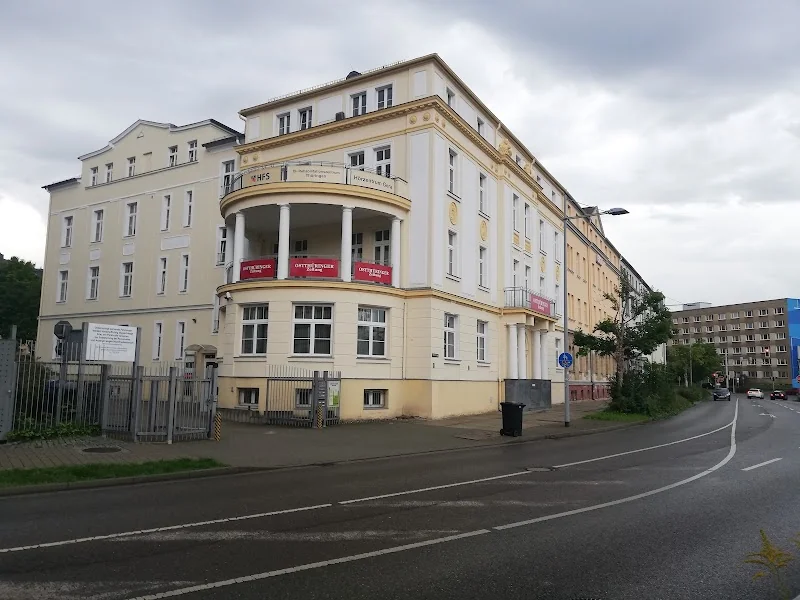
Gera
Theaterstraße 70, 07545 Gera, Deutschland
Herbert Feuchte FFBZ Gera | Early Intervention & Counseling
The Early Intervention and Counseling Center Gera of the Herbert Feuchte Foundation Network is an outpatient contact point for families seeking support for hearing impairments, autism, or communication needs. The website describes the center as a place where children and families are supported individually, resource-oriented, and in close collaboration with relatives and professionals. In Gera, the center is part of the Thuringian outpatient structure of the provider and complements its nationwide offerings of facilities and specialized services. This is particularly important for parents who are looking for guidance early on: Here, there are not only diagnostic and support perspectives but also counseling, daily assistance, and a clear professional structure. The offerings are not aimed at a single target group but connect several focal points that are often intertwined in everyday life. Hearing impairments, communication needs, and autism are not viewed in isolation but in the context of family, development, and social participation. Thus, the center in Gera is much more than a classic counseling location: it is a specialized, low-threshold, and professionally networked support for people who need reliable accompaniment. ([stiftungsverbund.de](https://stiftungsverbund.de/ambulant/thueringen/fruehfoerder-und-beratungszentrum-gera/))
Early Intervention for Hearing Impairments in Gera
The focus of the Early Intervention and Counseling Center for the Hearing Impaired is on early support and counseling for children with hearing impairments and their families. The official description emphasizes that the first three years of life are crucial because targeted auditory education can achieve a lot during this phase. Early intervention is not understood as an isolated measure but as a holistic process in which counseling and support are inseparable. The goal is to develop hearing ability or enable the child to communicate with their environment. This includes linguistic, motor, sensory, cognitive, emotional, and social developmental aspects. ([stiftungsverbund.de](https://stiftungsverbund.de/ambulant/ffbz-fachgebiete/fruehfoerderstelle-fuer-hoerbehinderte/))
Notably, there is also a close integration with other professional fields. According to the website, early intervention specialists work with specialized clinics, doctors, medical-therapeutic professionals, audiologists, rehabilitation centers, and childcare facilities. For families, this means short distances between counseling, medical assessment, and educational support. The site also mentions outpatient early intervention at the center and regional mobile early intervention in the family home or in the caring daycare center. This makes access particularly practical and flexible. Support is provided for children with hearing impairments, children with additional disabilities, children with a focus on communication, children with central auditory processing problems, and children of parents with hearing impairments. Thus, the FFBZ Gera covers a wide range without losing the individual perspective. The counseling is systematic but not schematic: it is oriented towards the needs of the family and the specific developmental steps of the child. ([stiftungsverbund.de](https://stiftungsverbund.de/ambulant/ffbz-fachgebiete/fruehfoerderstelle-fuer-hoerbehinderte/))
Autism Counseling for Children, Adolescents, and Adults
A second major focus in Gera is the counseling and support of autistic individuals and their families. The official website clearly states that autism, in its various forms, is understood as a relational and communication disorder that can impair the ability to establish normal emotional relationships with others. At the same time, it is emphasized that the services are not limited to a specific age: the center is there for autistic individuals of all ages. It assists with early detection, offers autism-specific support and therapies, and coordinates other necessary assistance. Here, too, close collaboration with medical institutions and specialists is central. ([stiftungsverbund.de](https://stiftungsverbund.de/ambulant/ffbz-fachgebiete/beratung-und-unterstuetzung-autistischer-menschen-und-ihrer-familien/))
The website also concretely shows how diverse the support can be. Mentioned are therapeutic initial and early diagnostics, support through TEACCH, PECS, and ABA, perceptual support according to Affolter or through sensory integration, interaction and communication training, support for social skills and independence, as well as counseling and information days for parents. Additionally, there is a central social aspect: the center aims to network families, enable exchange, and create relief in everyday life. For many affected individuals, this is crucial because uncertainties in daily life, at school, in social environments, or in communication can quickly lead to overwhelm. Therefore, the FFBZ Gera addresses not only the child or the individual but the entire support system. The counseling is designed for orientation, the support for participation, and the therapeutic accompaniment for stabilization in everyday life. ([stiftungsverbund.de](https://stiftungsverbund.de/ambulant/ffbz-fachgebiete/beratung-und-unterstuetzung-autistischer-menschen-und-ihrer-familien/))
Supported Communication as a Key to Participation
The third focus is counseling and early intervention in supported communication. The website describes that in Germany, about 300,000 people live who can hear but cannot speak verbally. For this target group, it is about overcoming barriers and breaking through the often-associated isolation. The center offers a wide range of pathways: from diagnosis to the provision of assistance adaptations and support with applications, to the planning of individual support programs, the support itself, and intensive counseling for affected individuals, parents, and caregivers. Thus, the FFBZ Gera connects professional analysis with very practical everyday assistance. ([stiftungsverbund.de](https://stiftungsverbund.de/ambulant/ffbz-fachgebiete/beratung-und-fruehfoerderung-in-unterstuetzter-kommunikation/))
Particularly important is the inclusion-oriented view of communication. The offerings are aimed at children, adolescents, and adults who understand spoken language well but can only express themselves to a limited extent, who need support in acquiring spoken language, or whose speech is only understandable with additional help. The website lists numerous methods and aids: nonverbal communication with objects, photos, images, and symbol systems, sign language and written language, supported communication, PECS, TEACCH, and electronic communication aids. Additionally, diagnostics, support, counseling, educational assessments, as well as networking and referral to doctors, therapists, and other professionals are included. The strength of this area lies in the understanding that communication is not an addition but a prerequisite for participation. Those who can communicate gain independence, social security, and often more peace in family life. This is exactly where the center in Gera focuses on its specialized expertise. ([stiftungsverbund.de](https://stiftungsverbund.de/ambulant/ffbz-fachgebiete/beratung-und-fruehfoerderung-in-unterstuetzter-kommunikation/))
Who the FFBZ Gera is There For
The Early Intervention and Counseling Center Gera is aimed at several target groups that may seem different at first glance but often have similar needs in practice. Mentioned are children with hearing impairments and additional disabilities, children with a focus on communication, children, adolescents, and adults on the autism spectrum, people who need support in communication, as well as relatives, professionals, and caregivers seeking counseling and exchange. This openness is particularly important because support needs in everyday life are rarely neatly separated from each other. A child may have a hearing impairment and simultaneously need communication support. An autistic person may benefit from structured communication. A family may need not only support for the child but also accompaniment, relief, and orientation. ([stiftungsverbund.de](https://stiftungsverbund.de/ambulant/thueringen/fruehfoerder-und-beratungszentrum-gera/))
The website also emphasizes the resource-oriented approach and the close collaboration with relatives and professionals. This means: the family is not seen as a marginal condition but as an active part of the support process. For many parents, this is an important quality factor because good early intervention only works sustainably if it reaches into everyday life and does not end at the practice door. The target group description also makes it clear that the center in Gera does not wait for a firmly established need for assistance but intervenes as early as possible in developmental processes. In the case of hearing impairments, the perspective ranges from the time of diagnosis to school entry, for autism, the offerings are cross-age, and for supported communication, the appropriate form of communication is central. This breadth is not a coincidence but an expression of a concept that thinks participation individually and does not adhere to rigid categories. ([stiftungsverbund.de](https://stiftungsverbund.de/ambulant/thueringen/fruehfoerder-und-beratungszentrum-gera/))
The Herbert Feuchte Foundation Network: History, Mission, and Structure
The Early Intervention and Counseling Center Gera is not isolated but is part of the Herbert Feuchte Foundation Network, whose history dates back to 1990. At that time, three foundations joined together to better coordinate assistance for multiply disabled hearing-impaired individuals. In 1994, the network was named Herbert Feuchte Foundation Network in honor of the life’s work of Dr. Herbert Feuchte, who had dedicated decades of commitment to the concerns of hearing-impaired individuals. The website describes that he became involved in these issues due to his own experience with the birth of his hearing-impaired daughter. In 2009, the network was transformed into a non-profit GmbH. Today, it sees itself as a social service company that supports and accompanies people with disabilities on their path to self-determined living. ([stiftungsverbund.de](https://stiftungsverbund.de/ueber-uns/unsere-geschichte/?utm_source=openai))
The scale of the provider shows how embedded the center in Gera is. The website mentions more than 35 facilities throughout Germany; it also states that hundreds of supported individuals and over 700 employees are involved. The network focuses on participation, social integration, and the best possible development of the individuals it accompanies. For the work in Gera, this means a combination of regional proximity and supra-regional experience. A FFBZ like the one on Theaterstraße 70 benefits from this structure because professional concepts, training, and organizational stability come together. At the same time, the local character remains important: families in Gera and the surrounding area receive a concrete, reachable contact point with its own team and clear responsibilities. Thus, a nationwide provider becomes a locally anchored support offer that works individually, professionally, and close to everyday life. ([stiftungsverbund.de](https://stiftungsverbund.de/ueber-uns/?utm_source=openai))
Location Theaterstraße 70 and Contact for Families
The contact page of the Early Intervention and Counseling Center Gera lists the address Theaterstraße 70, 07545 Gera, and the phone number 0365 55298677. Gabriele Kühn is listed as the director and Julia Walter as the team leader of FFBZ Gera. This information is particularly important for families because quick orientation counts in a stressful situation. The official page thus provides not only the location but also direct contacts. Those who have initial questions about hearing impairments, autism, or supported communication will find not only a general network structure but also concrete contact pathways. This lowers the threshold for entry, especially in early intervention and counseling. ([stiftungsverbund.de](https://stiftungsverbund.de/ambulant/thueringen/fruehfoerder-und-beratungszentrum-gera/))
Practically relevant is also that the page describes the center as an outpatient contact point and not as a large anonymous institution. This fits the entire self-understanding of the provider: proximity, professional specialization, and an individual perspective instead of a standard solution. The contact page presents the essential data clearly and without detours so that families, relatives, and professionals can act quickly. For initial intake, this is an advantage because uncertainty is often reduced through simple orientation. Those in need of support can start the process directly via phone or email and discuss the appropriate specialization in the next step. The website makes it clear that the center not only has offerings but also engages in relationship work: listening, categorizing, networking, and jointly finding the appropriate support path. This is what makes the location at Theaterstraße 70 an important address for families in Gera and the surrounding area. ([stiftungsverbund.de](https://stiftungsverbund.de/ambulant/thueringen/fruehfoerder-und-beratungszentrum-gera/))
Sources:
- Early Intervention and Counseling Center FFBZ Gera | Herbert Feuchte Foundation Network gGmbH
- Early Intervention Center for the Hearing Impaired | Herbert Feuchte Foundation Network
- Counseling and Support for Autistic Individuals and Their Families | Herbert Feuchte Foundation Network
- Counseling and Early Intervention in Supported Communication | Herbert Feuchte Foundation Network
- Our History | Herbert Feuchte Foundation Network gGmbH
- About Us | Herbert Feuchte Foundation Network gGmbH
Show moreShow less
Herbert Feuchte FFBZ Gera | Early Intervention & Counseling
The Early Intervention and Counseling Center Gera of the Herbert Feuchte Foundation Network is an outpatient contact point for families seeking support for hearing impairments, autism, or communication needs. The website describes the center as a place where children and families are supported individually, resource-oriented, and in close collaboration with relatives and professionals. In Gera, the center is part of the Thuringian outpatient structure of the provider and complements its nationwide offerings of facilities and specialized services. This is particularly important for parents who are looking for guidance early on: Here, there are not only diagnostic and support perspectives but also counseling, daily assistance, and a clear professional structure. The offerings are not aimed at a single target group but connect several focal points that are often intertwined in everyday life. Hearing impairments, communication needs, and autism are not viewed in isolation but in the context of family, development, and social participation. Thus, the center in Gera is much more than a classic counseling location: it is a specialized, low-threshold, and professionally networked support for people who need reliable accompaniment. ([stiftungsverbund.de](https://stiftungsverbund.de/ambulant/thueringen/fruehfoerder-und-beratungszentrum-gera/))
Early Intervention for Hearing Impairments in Gera
The focus of the Early Intervention and Counseling Center for the Hearing Impaired is on early support and counseling for children with hearing impairments and their families. The official description emphasizes that the first three years of life are crucial because targeted auditory education can achieve a lot during this phase. Early intervention is not understood as an isolated measure but as a holistic process in which counseling and support are inseparable. The goal is to develop hearing ability or enable the child to communicate with their environment. This includes linguistic, motor, sensory, cognitive, emotional, and social developmental aspects. ([stiftungsverbund.de](https://stiftungsverbund.de/ambulant/ffbz-fachgebiete/fruehfoerderstelle-fuer-hoerbehinderte/))
Notably, there is also a close integration with other professional fields. According to the website, early intervention specialists work with specialized clinics, doctors, medical-therapeutic professionals, audiologists, rehabilitation centers, and childcare facilities. For families, this means short distances between counseling, medical assessment, and educational support. The site also mentions outpatient early intervention at the center and regional mobile early intervention in the family home or in the caring daycare center. This makes access particularly practical and flexible. Support is provided for children with hearing impairments, children with additional disabilities, children with a focus on communication, children with central auditory processing problems, and children of parents with hearing impairments. Thus, the FFBZ Gera covers a wide range without losing the individual perspective. The counseling is systematic but not schematic: it is oriented towards the needs of the family and the specific developmental steps of the child. ([stiftungsverbund.de](https://stiftungsverbund.de/ambulant/ffbz-fachgebiete/fruehfoerderstelle-fuer-hoerbehinderte/))
Autism Counseling for Children, Adolescents, and Adults
A second major focus in Gera is the counseling and support of autistic individuals and their families. The official website clearly states that autism, in its various forms, is understood as a relational and communication disorder that can impair the ability to establish normal emotional relationships with others. At the same time, it is emphasized that the services are not limited to a specific age: the center is there for autistic individuals of all ages. It assists with early detection, offers autism-specific support and therapies, and coordinates other necessary assistance. Here, too, close collaboration with medical institutions and specialists is central. ([stiftungsverbund.de](https://stiftungsverbund.de/ambulant/ffbz-fachgebiete/beratung-und-unterstuetzung-autistischer-menschen-und-ihrer-familien/))
The website also concretely shows how diverse the support can be. Mentioned are therapeutic initial and early diagnostics, support through TEACCH, PECS, and ABA, perceptual support according to Affolter or through sensory integration, interaction and communication training, support for social skills and independence, as well as counseling and information days for parents. Additionally, there is a central social aspect: the center aims to network families, enable exchange, and create relief in everyday life. For many affected individuals, this is crucial because uncertainties in daily life, at school, in social environments, or in communication can quickly lead to overwhelm. Therefore, the FFBZ Gera addresses not only the child or the individual but the entire support system. The counseling is designed for orientation, the support for participation, and the therapeutic accompaniment for stabilization in everyday life. ([stiftungsverbund.de](https://stiftungsverbund.de/ambulant/ffbz-fachgebiete/beratung-und-unterstuetzung-autistischer-menschen-und-ihrer-familien/))
Supported Communication as a Key to Participation
The third focus is counseling and early intervention in supported communication. The website describes that in Germany, about 300,000 people live who can hear but cannot speak verbally. For this target group, it is about overcoming barriers and breaking through the often-associated isolation. The center offers a wide range of pathways: from diagnosis to the provision of assistance adaptations and support with applications, to the planning of individual support programs, the support itself, and intensive counseling for affected individuals, parents, and caregivers. Thus, the FFBZ Gera connects professional analysis with very practical everyday assistance. ([stiftungsverbund.de](https://stiftungsverbund.de/ambulant/ffbz-fachgebiete/beratung-und-fruehfoerderung-in-unterstuetzter-kommunikation/))
Particularly important is the inclusion-oriented view of communication. The offerings are aimed at children, adolescents, and adults who understand spoken language well but can only express themselves to a limited extent, who need support in acquiring spoken language, or whose speech is only understandable with additional help. The website lists numerous methods and aids: nonverbal communication with objects, photos, images, and symbol systems, sign language and written language, supported communication, PECS, TEACCH, and electronic communication aids. Additionally, diagnostics, support, counseling, educational assessments, as well as networking and referral to doctors, therapists, and other professionals are included. The strength of this area lies in the understanding that communication is not an addition but a prerequisite for participation. Those who can communicate gain independence, social security, and often more peace in family life. This is exactly where the center in Gera focuses on its specialized expertise. ([stiftungsverbund.de](https://stiftungsverbund.de/ambulant/ffbz-fachgebiete/beratung-und-fruehfoerderung-in-unterstuetzter-kommunikation/))
Who the FFBZ Gera is There For
The Early Intervention and Counseling Center Gera is aimed at several target groups that may seem different at first glance but often have similar needs in practice. Mentioned are children with hearing impairments and additional disabilities, children with a focus on communication, children, adolescents, and adults on the autism spectrum, people who need support in communication, as well as relatives, professionals, and caregivers seeking counseling and exchange. This openness is particularly important because support needs in everyday life are rarely neatly separated from each other. A child may have a hearing impairment and simultaneously need communication support. An autistic person may benefit from structured communication. A family may need not only support for the child but also accompaniment, relief, and orientation. ([stiftungsverbund.de](https://stiftungsverbund.de/ambulant/thueringen/fruehfoerder-und-beratungszentrum-gera/))
The website also emphasizes the resource-oriented approach and the close collaboration with relatives and professionals. This means: the family is not seen as a marginal condition but as an active part of the support process. For many parents, this is an important quality factor because good early intervention only works sustainably if it reaches into everyday life and does not end at the practice door. The target group description also makes it clear that the center in Gera does not wait for a firmly established need for assistance but intervenes as early as possible in developmental processes. In the case of hearing impairments, the perspective ranges from the time of diagnosis to school entry, for autism, the offerings are cross-age, and for supported communication, the appropriate form of communication is central. This breadth is not a coincidence but an expression of a concept that thinks participation individually and does not adhere to rigid categories. ([stiftungsverbund.de](https://stiftungsverbund.de/ambulant/thueringen/fruehfoerder-und-beratungszentrum-gera/))
The Herbert Feuchte Foundation Network: History, Mission, and Structure
The Early Intervention and Counseling Center Gera is not isolated but is part of the Herbert Feuchte Foundation Network, whose history dates back to 1990. At that time, three foundations joined together to better coordinate assistance for multiply disabled hearing-impaired individuals. In 1994, the network was named Herbert Feuchte Foundation Network in honor of the life’s work of Dr. Herbert Feuchte, who had dedicated decades of commitment to the concerns of hearing-impaired individuals. The website describes that he became involved in these issues due to his own experience with the birth of his hearing-impaired daughter. In 2009, the network was transformed into a non-profit GmbH. Today, it sees itself as a social service company that supports and accompanies people with disabilities on their path to self-determined living. ([stiftungsverbund.de](https://stiftungsverbund.de/ueber-uns/unsere-geschichte/?utm_source=openai))
The scale of the provider shows how embedded the center in Gera is. The website mentions more than 35 facilities throughout Germany; it also states that hundreds of supported individuals and over 700 employees are involved. The network focuses on participation, social integration, and the best possible development of the individuals it accompanies. For the work in Gera, this means a combination of regional proximity and supra-regional experience. A FFBZ like the one on Theaterstraße 70 benefits from this structure because professional concepts, training, and organizational stability come together. At the same time, the local character remains important: families in Gera and the surrounding area receive a concrete, reachable contact point with its own team and clear responsibilities. Thus, a nationwide provider becomes a locally anchored support offer that works individually, professionally, and close to everyday life. ([stiftungsverbund.de](https://stiftungsverbund.de/ueber-uns/?utm_source=openai))
Location Theaterstraße 70 and Contact for Families
The contact page of the Early Intervention and Counseling Center Gera lists the address Theaterstraße 70, 07545 Gera, and the phone number 0365 55298677. Gabriele Kühn is listed as the director and Julia Walter as the team leader of FFBZ Gera. This information is particularly important for families because quick orientation counts in a stressful situation. The official page thus provides not only the location but also direct contacts. Those who have initial questions about hearing impairments, autism, or supported communication will find not only a general network structure but also concrete contact pathways. This lowers the threshold for entry, especially in early intervention and counseling. ([stiftungsverbund.de](https://stiftungsverbund.de/ambulant/thueringen/fruehfoerder-und-beratungszentrum-gera/))
Practically relevant is also that the page describes the center as an outpatient contact point and not as a large anonymous institution. This fits the entire self-understanding of the provider: proximity, professional specialization, and an individual perspective instead of a standard solution. The contact page presents the essential data clearly and without detours so that families, relatives, and professionals can act quickly. For initial intake, this is an advantage because uncertainty is often reduced through simple orientation. Those in need of support can start the process directly via phone or email and discuss the appropriate specialization in the next step. The website makes it clear that the center not only has offerings but also engages in relationship work: listening, categorizing, networking, and jointly finding the appropriate support path. This is what makes the location at Theaterstraße 70 an important address for families in Gera and the surrounding area. ([stiftungsverbund.de](https://stiftungsverbund.de/ambulant/thueringen/fruehfoerder-und-beratungszentrum-gera/))
Sources:
- Early Intervention and Counseling Center FFBZ Gera | Herbert Feuchte Foundation Network gGmbH
- Early Intervention Center for the Hearing Impaired | Herbert Feuchte Foundation Network
- Counseling and Support for Autistic Individuals and Their Families | Herbert Feuchte Foundation Network
- Counseling and Early Intervention in Supported Communication | Herbert Feuchte Foundation Network
- Our History | Herbert Feuchte Foundation Network gGmbH
- About Us | Herbert Feuchte Foundation Network gGmbH
Herbert Feuchte FFBZ Gera | Early Intervention & Counseling
The Early Intervention and Counseling Center Gera of the Herbert Feuchte Foundation Network is an outpatient contact point for families seeking support for hearing impairments, autism, or communication needs. The website describes the center as a place where children and families are supported individually, resource-oriented, and in close collaboration with relatives and professionals. In Gera, the center is part of the Thuringian outpatient structure of the provider and complements its nationwide offerings of facilities and specialized services. This is particularly important for parents who are looking for guidance early on: Here, there are not only diagnostic and support perspectives but also counseling, daily assistance, and a clear professional structure. The offerings are not aimed at a single target group but connect several focal points that are often intertwined in everyday life. Hearing impairments, communication needs, and autism are not viewed in isolation but in the context of family, development, and social participation. Thus, the center in Gera is much more than a classic counseling location: it is a specialized, low-threshold, and professionally networked support for people who need reliable accompaniment. ([stiftungsverbund.de](https://stiftungsverbund.de/ambulant/thueringen/fruehfoerder-und-beratungszentrum-gera/))
Early Intervention for Hearing Impairments in Gera
The focus of the Early Intervention and Counseling Center for the Hearing Impaired is on early support and counseling for children with hearing impairments and their families. The official description emphasizes that the first three years of life are crucial because targeted auditory education can achieve a lot during this phase. Early intervention is not understood as an isolated measure but as a holistic process in which counseling and support are inseparable. The goal is to develop hearing ability or enable the child to communicate with their environment. This includes linguistic, motor, sensory, cognitive, emotional, and social developmental aspects. ([stiftungsverbund.de](https://stiftungsverbund.de/ambulant/ffbz-fachgebiete/fruehfoerderstelle-fuer-hoerbehinderte/))
Notably, there is also a close integration with other professional fields. According to the website, early intervention specialists work with specialized clinics, doctors, medical-therapeutic professionals, audiologists, rehabilitation centers, and childcare facilities. For families, this means short distances between counseling, medical assessment, and educational support. The site also mentions outpatient early intervention at the center and regional mobile early intervention in the family home or in the caring daycare center. This makes access particularly practical and flexible. Support is provided for children with hearing impairments, children with additional disabilities, children with a focus on communication, children with central auditory processing problems, and children of parents with hearing impairments. Thus, the FFBZ Gera covers a wide range without losing the individual perspective. The counseling is systematic but not schematic: it is oriented towards the needs of the family and the specific developmental steps of the child. ([stiftungsverbund.de](https://stiftungsverbund.de/ambulant/ffbz-fachgebiete/fruehfoerderstelle-fuer-hoerbehinderte/))
Autism Counseling for Children, Adolescents, and Adults
A second major focus in Gera is the counseling and support of autistic individuals and their families. The official website clearly states that autism, in its various forms, is understood as a relational and communication disorder that can impair the ability to establish normal emotional relationships with others. At the same time, it is emphasized that the services are not limited to a specific age: the center is there for autistic individuals of all ages. It assists with early detection, offers autism-specific support and therapies, and coordinates other necessary assistance. Here, too, close collaboration with medical institutions and specialists is central. ([stiftungsverbund.de](https://stiftungsverbund.de/ambulant/ffbz-fachgebiete/beratung-und-unterstuetzung-autistischer-menschen-und-ihrer-familien/))
The website also concretely shows how diverse the support can be. Mentioned are therapeutic initial and early diagnostics, support through TEACCH, PECS, and ABA, perceptual support according to Affolter or through sensory integration, interaction and communication training, support for social skills and independence, as well as counseling and information days for parents. Additionally, there is a central social aspect: the center aims to network families, enable exchange, and create relief in everyday life. For many affected individuals, this is crucial because uncertainties in daily life, at school, in social environments, or in communication can quickly lead to overwhelm. Therefore, the FFBZ Gera addresses not only the child or the individual but the entire support system. The counseling is designed for orientation, the support for participation, and the therapeutic accompaniment for stabilization in everyday life. ([stiftungsverbund.de](https://stiftungsverbund.de/ambulant/ffbz-fachgebiete/beratung-und-unterstuetzung-autistischer-menschen-und-ihrer-familien/))
Supported Communication as a Key to Participation
The third focus is counseling and early intervention in supported communication. The website describes that in Germany, about 300,000 people live who can hear but cannot speak verbally. For this target group, it is about overcoming barriers and breaking through the often-associated isolation. The center offers a wide range of pathways: from diagnosis to the provision of assistance adaptations and support with applications, to the planning of individual support programs, the support itself, and intensive counseling for affected individuals, parents, and caregivers. Thus, the FFBZ Gera connects professional analysis with very practical everyday assistance. ([stiftungsverbund.de](https://stiftungsverbund.de/ambulant/ffbz-fachgebiete/beratung-und-fruehfoerderung-in-unterstuetzter-kommunikation/))
Particularly important is the inclusion-oriented view of communication. The offerings are aimed at children, adolescents, and adults who understand spoken language well but can only express themselves to a limited extent, who need support in acquiring spoken language, or whose speech is only understandable with additional help. The website lists numerous methods and aids: nonverbal communication with objects, photos, images, and symbol systems, sign language and written language, supported communication, PECS, TEACCH, and electronic communication aids. Additionally, diagnostics, support, counseling, educational assessments, as well as networking and referral to doctors, therapists, and other professionals are included. The strength of this area lies in the understanding that communication is not an addition but a prerequisite for participation. Those who can communicate gain independence, social security, and often more peace in family life. This is exactly where the center in Gera focuses on its specialized expertise. ([stiftungsverbund.de](https://stiftungsverbund.de/ambulant/ffbz-fachgebiete/beratung-und-fruehfoerderung-in-unterstuetzter-kommunikation/))
Who the FFBZ Gera is There For
The Early Intervention and Counseling Center Gera is aimed at several target groups that may seem different at first glance but often have similar needs in practice. Mentioned are children with hearing impairments and additional disabilities, children with a focus on communication, children, adolescents, and adults on the autism spectrum, people who need support in communication, as well as relatives, professionals, and caregivers seeking counseling and exchange. This openness is particularly important because support needs in everyday life are rarely neatly separated from each other. A child may have a hearing impairment and simultaneously need communication support. An autistic person may benefit from structured communication. A family may need not only support for the child but also accompaniment, relief, and orientation. ([stiftungsverbund.de](https://stiftungsverbund.de/ambulant/thueringen/fruehfoerder-und-beratungszentrum-gera/))
The website also emphasizes the resource-oriented approach and the close collaboration with relatives and professionals. This means: the family is not seen as a marginal condition but as an active part of the support process. For many parents, this is an important quality factor because good early intervention only works sustainably if it reaches into everyday life and does not end at the practice door. The target group description also makes it clear that the center in Gera does not wait for a firmly established need for assistance but intervenes as early as possible in developmental processes. In the case of hearing impairments, the perspective ranges from the time of diagnosis to school entry, for autism, the offerings are cross-age, and for supported communication, the appropriate form of communication is central. This breadth is not a coincidence but an expression of a concept that thinks participation individually and does not adhere to rigid categories. ([stiftungsverbund.de](https://stiftungsverbund.de/ambulant/thueringen/fruehfoerder-und-beratungszentrum-gera/))
The Herbert Feuchte Foundation Network: History, Mission, and Structure
The Early Intervention and Counseling Center Gera is not isolated but is part of the Herbert Feuchte Foundation Network, whose history dates back to 1990. At that time, three foundations joined together to better coordinate assistance for multiply disabled hearing-impaired individuals. In 1994, the network was named Herbert Feuchte Foundation Network in honor of the life’s work of Dr. Herbert Feuchte, who had dedicated decades of commitment to the concerns of hearing-impaired individuals. The website describes that he became involved in these issues due to his own experience with the birth of his hearing-impaired daughter. In 2009, the network was transformed into a non-profit GmbH. Today, it sees itself as a social service company that supports and accompanies people with disabilities on their path to self-determined living. ([stiftungsverbund.de](https://stiftungsverbund.de/ueber-uns/unsere-geschichte/?utm_source=openai))
The scale of the provider shows how embedded the center in Gera is. The website mentions more than 35 facilities throughout Germany; it also states that hundreds of supported individuals and over 700 employees are involved. The network focuses on participation, social integration, and the best possible development of the individuals it accompanies. For the work in Gera, this means a combination of regional proximity and supra-regional experience. A FFBZ like the one on Theaterstraße 70 benefits from this structure because professional concepts, training, and organizational stability come together. At the same time, the local character remains important: families in Gera and the surrounding area receive a concrete, reachable contact point with its own team and clear responsibilities. Thus, a nationwide provider becomes a locally anchored support offer that works individually, professionally, and close to everyday life. ([stiftungsverbund.de](https://stiftungsverbund.de/ueber-uns/?utm_source=openai))
Location Theaterstraße 70 and Contact for Families
The contact page of the Early Intervention and Counseling Center Gera lists the address Theaterstraße 70, 07545 Gera, and the phone number 0365 55298677. Gabriele Kühn is listed as the director and Julia Walter as the team leader of FFBZ Gera. This information is particularly important for families because quick orientation counts in a stressful situation. The official page thus provides not only the location but also direct contacts. Those who have initial questions about hearing impairments, autism, or supported communication will find not only a general network structure but also concrete contact pathways. This lowers the threshold for entry, especially in early intervention and counseling. ([stiftungsverbund.de](https://stiftungsverbund.de/ambulant/thueringen/fruehfoerder-und-beratungszentrum-gera/))
Practically relevant is also that the page describes the center as an outpatient contact point and not as a large anonymous institution. This fits the entire self-understanding of the provider: proximity, professional specialization, and an individual perspective instead of a standard solution. The contact page presents the essential data clearly and without detours so that families, relatives, and professionals can act quickly. For initial intake, this is an advantage because uncertainty is often reduced through simple orientation. Those in need of support can start the process directly via phone or email and discuss the appropriate specialization in the next step. The website makes it clear that the center not only has offerings but also engages in relationship work: listening, categorizing, networking, and jointly finding the appropriate support path. This is what makes the location at Theaterstraße 70 an important address for families in Gera and the surrounding area. ([stiftungsverbund.de](https://stiftungsverbund.de/ambulant/thueringen/fruehfoerder-und-beratungszentrum-gera/))
Sources:
- Early Intervention and Counseling Center FFBZ Gera | Herbert Feuchte Foundation Network gGmbH
- Early Intervention Center for the Hearing Impaired | Herbert Feuchte Foundation Network
- Counseling and Support for Autistic Individuals and Their Families | Herbert Feuchte Foundation Network
- Counseling and Early Intervention in Supported Communication | Herbert Feuchte Foundation Network
- Our History | Herbert Feuchte Foundation Network gGmbH
- About Us | Herbert Feuchte Foundation Network gGmbH
Upcoming Events
No events found
Frequently Asked Questions
Reviews
No reviews found